 Deal Scanner
Facebook Marketplace
A Facebook Marketplace deal finder that knows the going price
A Marketplace deal finder does two jobs: it knows what an item usually goes for near you, and it tells you when one is listed under that. How to do both by hand, the red flags that fake a deal, and how Deal Scanner's Deal Score does it on your phone.
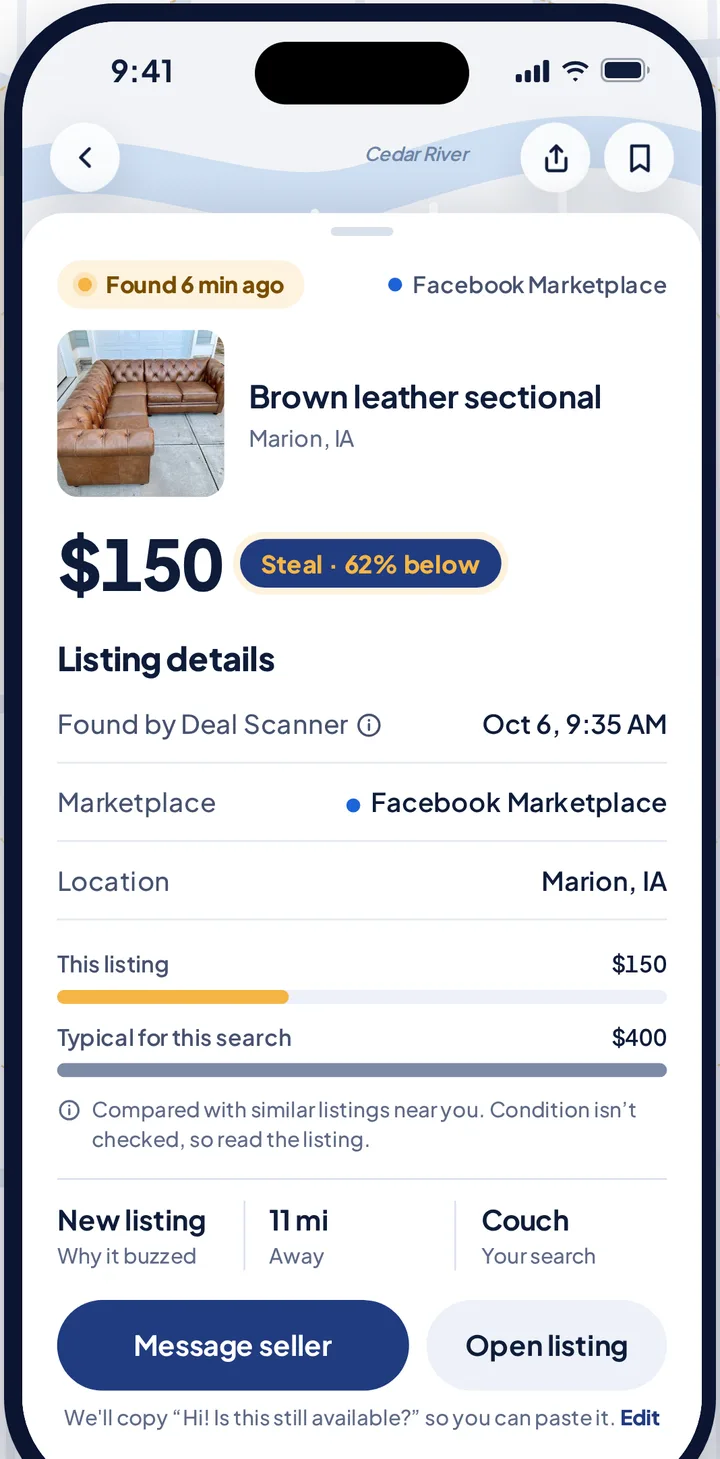
A Facebook Marketplace deal finder has two jobs. First, know what the item usually sells for near you, because "cheap" only means something against that number. Second, tell you when one gets listed under it, fast, because a real deal is gone the same day. Facebook does neither: it has no price history and its saved-search notifications are hours to days late in our use. You can do both by hand, and how is below. Or Deal Scanner does both for you: it watches Facebook Marketplace, OfferUp and Craigslist for your search, buzzes you when a matching listing is posted, and puts a Deal Score on each find showing how far under the typical price near you it sits ("46% below typical").
What makes something a deal
A deal is the asking price against what the same thing goes for near you, right now. Not the original retail price. Not what the seller says it's worth. Not one listing in another state.
- A Herman Miller Aeron at $350 is a deal if they usually list at $600 in your area, and nothing special if half a dozen are up at $350 already.
- A 2015 F-150 $2,000 under the others with similar miles is a deal. $2,000 under because it needs a transmission is not.
- A seller who dropped the price twice is telling you something, but the cut isn't the deal. The price against typical is the deal.
How to find the typical price by hand
- Search the exact model near you. "PS5 disc," not "PlayStation." Set your town and the radius you'd drive.
- Look at 10 to 20 listings, not the first three. Skip the bundles, the broken ones and the obvious bait.
- Note which ones went fast. A listing marked sold within a day was priced right or under. One still up after three weeks was priced high.
- Check OfferUp and Craigslist for the same item. The same mower or sectional is often on all three the same day, sometimes at different prices.
- Write the middle number down. That's typical. Anything well under it is worth a message today.
Our price pages show the typical asking price for common items by area, from a live data refresh: PS5, F-150, Silverado, riding mowers, generators, snowblowers, sectionals and more.
Red flags that fake a deal
A price far under typical is one of two things: the deal you want, or a scam priced to make you hurry. Too good to be true means it is when you see:
- Stock or catalog photos, or the same photos on another listing.
- A brand-new profile, or one with no history in your area.
- "Shipping only," a seller who's out of town, or anything that keeps you from seeing it.
- Any request for a deposit, a Venmo to hold it, or a verification code.
Every version is on Facebook Marketplace scams. A listing that passes those checks and is still well under typical is a deal. Message with a specific time: "Is the Aeron still available at $350? I can come tonight with cash."
Where deals come from
- The seller who wants it gone. Moving, new one on the way, garage needs to be empty by Saturday. Priced low on purpose. These go within hours.
- The seller who doesn't know what they have. A Milwaukee kit listed as "drill set," a vague title, bad photos. Search the nicknames and the misspellings too.
- Fresh listings. A fair price is a deal for whoever sees it first. By the time most people message, the listing says "posted yesterday" and there are ten guys ahead of you.
More on each kind and the search for it: how to find deals on Facebook Marketplace.
You have to see the deal for it to happen
Every time I found a cheap car that ran and messaged the seller: sorry, already sold, or there's ten guys ahead of you. The listing was posted yesterday, or two days ago. I knew a deal when I saw one. I just wasn't seeing them in time. You can't sit there refreshing Marketplace every five minutes.
Why Facebook isn't a deal finder
- No typical price. Facebook shows the asking price and nothing to compare it to.
- Late notifications. Saved-search notifications are hours to days late in our use, loosely filtered, and they turn themselves off.
- No low price limit on alerts. The $15 controller shows up on your PS5 search.
- Facebook only. The same item on OfferUp or Craigslist never reaches you.
- Meta AI and Muse are a chat, not a watch. They'll look when you ask. Nothing stands guard between questions.
How Deal Scanner finds the deal
Set one search: the item, your town, how far you'd drive, and a low and high price. Deal Scanner watches Facebook Marketplace, OfferUp and Craigslist from that search, from its own servers, with the app closed. It drops most accessories and lookalikes and buzzes you when a matching listing is posted.
- Deal Score on every find. How far under the typical price near you the listing sits, so you know in one look whether to message now.
- Price drops built in. When a listing your search matches gets at least 5% cheaper, or one over your high limit drops into your range, your phone buzzes with "was $X, now $Y." Nothing to turn on.
- When it found it. Every alert shows when Deal Scanner found the listing, so you know how fresh it is.
- No Facebook login, ever.
Three searches are $3.99 a month, cancel anytime in your phone's subscription settings. Pay for the month you're looking. Cancel when you've got it. Hunter is $9.99 for 6 searches and Pro is $19.99 for 12; every plan watches all three marketplaces at the same speed. It's for everybody who checks Marketplace, whether flipping is your side thing, your whole job, or not the point at all.
More on the alerts for each marketplace: Facebook Marketplace alerts, OfferUp alerts, Craigslist alerts. Every other Marketplace app's price, checked on its own site, is on best Facebook Marketplace alert apps.
FAQ
Is there a deal finder for Facebook Marketplace?
Facebook doesn't have one built in. It shows asking prices with nothing to compare them to. Deal Scanner watches Facebook Marketplace, OfferUp and Craigslist for your search, buzzes you when a matching listing is posted, and scores each one against the typical price near you.
How do I know if something on Marketplace is a good deal?
Compare it to the typical asking price for the same model near you: look at 10 to 20 listings, note which sold fast, and take the middle. Anything well under that, with real photos and no deposit request, is a deal.
What is a Deal Score?
Deal Scanner's Deal Score shows how far under the typical price near you a listing sits, for example "46% below typical." It's on each find, so you can tell at a glance whether to message now.
Why do Marketplace deals sell so fast?
Because everybody else is looking for the same thing. A fairly priced listing gets messages within the hour, and the first person who can show up with cash usually gets it. Hearing about it first matters as much as the price.
Is a Marketplace listing that's way under price a scam?
Sometimes. Stock photos, a new profile, "shipping only" or any request for a deposit or code means walk away. A listing that passes those checks and is still under typical is usually just a seller who wants it gone.
How much does Deal Scanner cost?
$3.99 a month for three searches, cancel anytime in your phone's subscription settings. Hunter is $9.99 for 6 and Pro is $19.99 for 12, and yearly gives two months free.
Sources checked
The current top Google results for "facebook marketplace deal finder" (Swoopa's and DealScout's home pages, DealFlip AI's home page, and the Chrome Web Store deal-scoring extensions) for what they cover; Deal Scanner's price pages and marketplace data from the October 27, 2026 refresh; our scams page. Checked November 2, 2026.
Also: Facebook Marketplace alerts OfferUp alerts Craigslist alerts Compare 14 alert apps Alert app for iPhone and Android Free alert options Marketplace scanner Marketplace monitor One app for all three Notifications not working? Set up Facebook's own alerts Swoopa alternatives Swoopa pricing Flipify alternatives DealScout alternatives