 Deal Scanner
Buying used
Buying a first car on Facebook Marketplace
How to buy a 16-year-old's first car from a private seller on Facebook Marketplace, OfferUp or Craigslist: the real budget, which cars to look at, the title and VIN, the parking-lot checks, the test drive, paying safely, the paperwork, and how to hear about the right car when it is posted.
A first car bought from a private seller on Facebook Marketplace, OfferUp or Craigslist should be boring, common, cheap to insure and cheap to fix: a Corolla, a Civic, a Camry, an Impala, a Fusion, a Focus, an older Escape or CR-V. Set the budget with insurance and the first repair inside it, run the VIN before you drive out, check the title is in the seller's name, do the checks below in the parking lot, take it on the highway, and do the money at the bank with the title signed over there. The good ones at a fair price are gone in a day, so the last part of this page is about seeing the listing before the other ten parents do.
The real budget
The price on the listing is about two-thirds of the first-year cost. Before you set a number, add up:
- Insurance. A 16-year-old on a policy is the biggest line, and it changes a lot by car. A 2009 Corolla and a 2009 Mustang are the same price on Marketplace and nowhere near the same price to insure. Call your insurer with two or three candidate models before you shop, not after.
- Title, tax and plates. Sales tax on a private sale is paid at the DMV when the title is transferred in most states, plus a title fee and registration. Budget a few hundred dollars on a $5,000 car.
- The first repair. Every used car needs something in the first six months: tires, brakes, a battery. Keep $500 to $1,000 back for it, and a car that needs that money now should be priced with it taken off.
- What's left is the car. If the whole budget is $6,000, the listing price you are shopping is about $4,500. That is still plenty for a car that runs for years.
Which cars to look at
The right first car is the one every mechanic in town has fixed a hundred times. Parts are cheap, the fix is quick, and the car does not surprise anybody:
- Small and mid-size sedans: Toyota Corolla and Camry, Honda Civic and Accord, Mazda3, Ford Fusion and Focus, Chevy Malibu and Impala, Hyundai Elantra, Nissan Altima (check the transmission on the CVT years).
- Small SUVs if winter is a thing where you live: Honda CR-V, Toyota RAV4, Ford Escape, Subaru Forester and Outback (ask about head gaskets on the older ones).
- An older pickup if the kid needs one for work, with the same frame and rust checks as any used truck.
Skip for a first car: anything with a turbo and a body kit, a lifted anything, a luxury badge over 10 years old (the parts cost what the car cost), and anything the seller describes as "fun." Fun is what a first car is not supposed to be. Also skip a rebuilt or salvage title. It is cheaper for a reason, and your insurer may not cover it the same way.
Before you drive out
- Ask for the VIN and a photo of the title. A seller who will not send the VIN is done. Match the VIN on the title to the VIN on the dash and the door jamb when you get there.
- Run the VIN. The NICB VINCheck is free and shows theft and total-loss records. A paid history report adds accidents, odometer readings, title branding (salvage, rebuilt, flood, lemon) and how many owners. Twenty dollars against a $5,000 car.
- The title has to be in the seller's name. "Title in my cousin's name," "I never transferred it," "open title" and "lost title, I'll get a duplicate after you pay" are all your problem the day after you hand over cash. If there is a lien, you meet at that bank and the bank releases it with you standing there.
- Ask the plain questions. Why are you selling it. What has been done in the last year. Does it have any lights on the dash. Where has it lived (salt-belt cars rust from underneath). The answers matter less than how fast and straight they come.
- Look at the listing itself. Photos of the whole car in daylight, the odometer, the dash with the key on. A listing with one photo and the words "runs great, needs nothing" at half the going price is the scam, not the deal.
In the parking lot
Bring a flashlight, a cheap code reader, paper towels, and a friend. Do this before the test drive, with the engine cold. Ask the seller ahead of time not to warm it up.
- Cold start. Watch the exhaust. Blue smoke is oil, white smoke that does not clear is coolant, a long crank is a problem. Listen for a tick that does not fade.
- Codes. Plug the reader into the port under the dash. Stored codes, pending codes, and whether the monitors read "not ready" (a seller who just cleared a code leaves them that way).
- Oil and coolant. Oil that looks like a milkshake is a head gasket. Coolant should be clean and the right color, not brown or oily.
- Transmission. On the dipstick if it has one: red or pink, not brown, no burnt smell. On the drive: shifts you do not notice. A CVT that shudders or whines is a car you do not buy.
- Tires. Date code on the sidewall (four digits, week and year). Matched tread and a set under six years old is $600 you do not have to spend. Uneven wear is an alignment or worn front-end parts.
- Brakes. Look through the wheel at the rotor. Deep grooves or a lip at the edge means pads and rotors soon.
- Rust. Underneath with the flashlight: rocker panels, the floor under the doors, the subframe, the strut towers under the hood. Surface rust is normal. Flaking scale and soft spots are not.
- Body. Panel gaps, paint that does not match in sunlight, overspray on the trim, one door a shade off: a repaired crash. Not always a deal-breaker, but it should be in the price and on the history report.
- Everything electrical. Windows, locks, heat, air conditioning, wipers, every light. Air conditioning that "just needs a recharge" is usually a leak that costs more than the recharge.
- Airbag light. If it stays on, the airbags may not work. On a 16-year-old's car that is the end of the inspection.
The test drive
A real one, twenty minutes, with the radio off and the windows down for the first half:
- City streets for the brakes (straight stop, no pulsing, no squeal) and the steering (centered, no clunk over bumps).
- Highway speed for a shimmy, a drift, a whine that climbs with speed, and the transmission's top gear.
- A parking lot for full-lock turns both ways (clicking on a front-wheel-drive car is a CV joint).
- Let the kid drive it too. They are going to be in it every day. If it feels wrong to them, listen.
If the car is near the top of your budget, pay a shop for a pre-purchase inspection before you buy. An hour of labor, and the best money in the deal. A seller who will not let you take it to a shop has told you what you need to know.
Paying and the paperwork
- No deposits. Not to hold it, not to "take it off Marketplace," not by Zelle, Venmo or Cash App, not for any reason. Too good to be true means it is.
- Cash or a cashier's check, at a bank, in daylight. The bank is a camera, a notary and a safe place all at once, and the seller's lien, if there is one, gets released right there.
- Sign the title correctly. The seller signs as the seller, in the right box, with the odometer reading. Do not accept a title already signed by someone else (that is title jumping, and it is illegal in most states). Do not let anybody tell you to leave the buyer line blank.
- Bill of sale. Year, make, model, VIN, price, date, both names, both signatures, "sold as is." Many states require one; all of them are easier with one.
- Whose name goes on it. In most states a minor cannot hold a title or register a car, and insurers want the owner on the policy, so the car usually goes in a parent's name with the teen listed as a driver. Check your state's DMV page before you go to the bank so you know who signs.
- Insure it before it moves. Call the insurer from the bank parking lot. Then the DMV for the title transfer and plates inside your state's deadline, usually 10 to 30 days.
Why this page exists
I was looking for a cheap car to save on gas and keep miles off my truck. Something that ran and didn't need a new engine or a timing belt. Every time I found one and messaged the seller: sorry, already sold, or there's ten guys ahead of you. And the listing was posted yesterday, or two days ago. I had work all day. You can't sit there refreshing Marketplace every five minutes. It took me almost two months to find a car, and honestly I just got lucky. You have to see the deal for it to happen.
Is the price good?
A first car's price depends on the model, year, mileage, condition, title status and where you live, and all of it moves with the season (sedans are cheaper in winter, four-wheel drive is not). Guides give a national number. The honest comparison is with the last several of the same car asking near you right now. Deal Scanner does that for you: once a search has seen a few listings, each new one gets a Deal Score showing how far under the typical asking price near you it sits. The ones far below typical are worth the drive, after the VIN and title check out and the car passes the parking lot.
Hearing about it first
The right first car at a fair price sells the day it is posted, usually to whoever saw it first. Facebook's own saved-search notifications are hours to days late, loosely filtered, and turn themselves off without telling you, so by the time your phone buzzes it is "posted yesterday, ten guys ahead of you." The fixes for those are on Facebook Marketplace alerts, and the same job on the other two sites is on Craigslist alerts and OfferUp alerts.
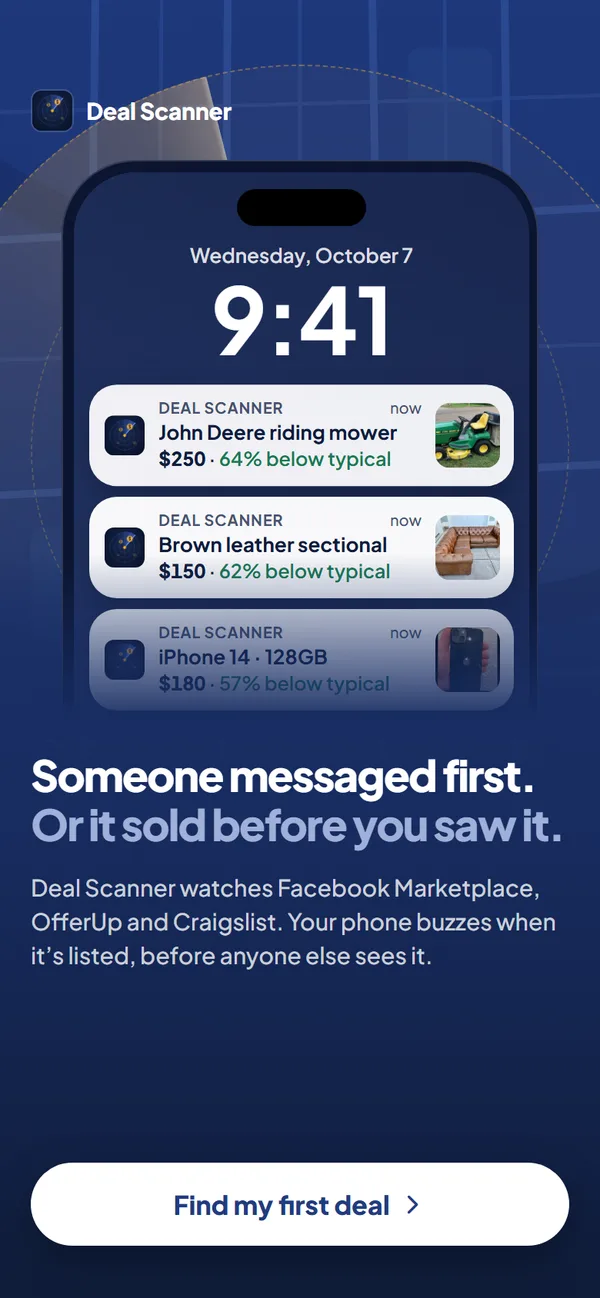
The simpler way is one Deal Scanner search per model: "Corolla", your town, how far you would drive, and a price range with a real low limit so the $800 "no title, blown head gasket" listings stay off your phone. Deal Scanner watches Facebook Marketplace, OfferUp and Craigslist from that one search, with the app closed, and buzzes you when a listing is posted, Deal Score attached and stamped with when it found it. Three searches are $3.99 a month, so you can watch a Corolla, a Civic and a Fusion at once. You cancel anytime in your phone's subscription settings. Pay for the month you're looking. Cancel when you've got it. Next kid, next time, download it again.
The other apps that do this are priced like business software, for people who flip cars for a living. The list, with prices checked on each app's own site, is on best Facebook Marketplace alert apps.
FAQ
What is a good first car to buy on Facebook Marketplace?
A common, cheap-to-fix, cheap-to-insure sedan or small SUV: Corolla, Civic, Camry, Accord, Mazda3, Fusion, Focus, Malibu, Impala, Elantra, CR-V, RAV4, Escape. Skip turbos, lifts, old luxury badges and salvage titles.
How much should a teenager's first car cost?
Whatever is left after insurance, tax, title and plates, and $500 to $1,000 held back for the first repair. On a $6,000 total budget that is roughly a $4,500 car.
Can a 16-year-old buy a car on Facebook Marketplace?
They can find it and negotiate it, but in most states a minor cannot hold a title or register a vehicle, and the insurance has to be in an adult's name. The car usually goes in a parent's name with the teen listed as a driver. Check your state's DMV page.
What should I check before buying a used car from a private seller?
The VIN history and the title first, then a cold start, stored codes, oil and coolant, the transmission, tires, brakes, rust underneath, body repair evidence, every electrical item, the airbag light, and a 20-minute test drive including highway. A shop inspection for anything near the top of your budget.
How do I pay safely for a car on Facebook Marketplace?
Never a deposit. Cash or a cashier's check at a bank, in daylight, with the title signed over by the owner on the title and a bill of sale for both of you.
How do I get alerts when a car is listed near me?
Set a Deal Scanner search for the model, your town, a radius and a price range. It watches Facebook Marketplace, OfferUp and Craigslist and buzzes your phone when a match is posted, with a Deal Score against the typical price near you.
Sources checked
NICB VINCheck (nicb.org); state DMV guidance on title transfers, minors and private-sale tax; Facebook's, OfferUp's and Craigslist's own safety pages on meeting and payment; Deal Scanner's own price pages for how typical prices are figured. Checked October 29, 2026.
Also: Buying a used kayak Buying a used zero-turn mower Buying a used camper Buying a used jet ski Buying a used generator Buying a used snowmobile Buying a used snowblower Best things to flip on Facebook Marketplace Buying a used boat Buying a used dirt bike Buying a used four-wheeler Buying a used golf cart Buying a used lawn mower Buying a used motorcycle Buying a used trailer Buying a used truck Buying used appliances Buying used furniture Buying used tools Facebook Marketplace fees Facebook Marketplace scams Marketplace tips for buyers How to find deals on Facebook Marketplace How to negotiate on Facebook Marketplace Is Facebook Marketplace safe Facebook Marketplace alerts OfferUp alerts Craigslist alerts Compare 14 alert apps Alert app for iPhone and Android Free alert options Marketplace scanner Marketplace monitor One app for all three Notifications not working? Set up Facebook's own alerts Swoopa alternatives Swoopa pricing Flipify alternatives DealScout alternatives