 Deal Scanner
Buying used
Buying a used kayak from a private seller
How to buy a used kayak from a private seller: sit-on-top or sit-inside, fishing, pedal, tandem or inflatable, the hull, the scupper holes, hatches and seals, the seat and foot braces, a leak test, the hull number, what a used kayak costs right now, when prices are lowest, getting it home, and how to hear about the right one when it is posted.
A used kayak from a private seller is a good buy if the hull has no cracks, no deep gouges and no creased dents, the plastic is not faded and brittle from years in the sun, it does not take on water, the seat and foot braces adjust and lock, and the hull number on the back has not been ground off. Scratches on the bottom are normal and mean nothing. A kayak has no engine, so a careful ten minutes with a flashlight tells you nearly everything. The typical asking price for a used kayak in Deal Scanner's own listings is $300, and fall and winter are the cheapest time to buy. The details are below, along with how to be the first one to the good listing.
Which kind
- Sit-on-top. You sit on the deck, not in a cockpit. Stable, easy to climb back onto, drains itself through scupper holes in the floor. The usual pick for warm water, fishing and beginners.
- Sit-inside. You sit in a cockpit with your legs under the deck. Drier and warmer, faster for its length, and the one to buy for cold water or longer trips. Short wide ones are recreational boats; long narrow ones with sealed compartments front and back are touring or sea kayaks.
- Fishing. A wide sit-on-top with rod holders, gear tracks and a raised seat. Heavy. Many are 80 pounds or more before you add anything.
- Pedal drive. A fishing or recreational kayak with a drive you pedal, fins or a propeller, so your hands stay free. The drive is the expensive part of the boat. Make sure it is included and that it works.
- Tandem. Two seats. Good with a kid or a dog, long and heavy to move alone.
- Inflatable. Fits in a trunk and a closet. Slower, and the check is different: seams, valves and whether it holds air.
- What it is made of. Most used kayaks are molded polyethylene plastic: heavy, tough, cheap, and the dents and sun damage on this page are about it. Lighter thermoformed and fiberglass or composite boats cost more, paddle better, and crack instead of denting.
Before you shop, know the two numbers that decide whether you will use it: how much it weighs and how long it is. A kayak you cannot lift onto your car alone stays in the garage.
Before you drive out
- Get the brand, the exact model, the length and the year if they know it. Look up what that model costs new and how much it weighs. Half the listings just say "kayak," and a $250 big-box boat and a $1,200 touring boat can look alike in one photo.
- Ask how it was stored. Indoors or under cover, on its side or hung in wide straps is right. Outside in the sun for years, or flat on its hull on two sawhorses, is how a plastic kayak gets brittle and dented.
- Ask what comes with it. A paddle, a seat, a life jacket, a cart, roof rack cradles, the pedal drive, a rudder. A decent paddle and life jacket are real money bought new, so they change what the price means.
- Ask whether it leaks and whether it has ever been repaired. Then ask for a photo of the bottom, the whole bottom, before you drive.
- Ask for the hull number. Kayaks have a twelve-character hull identification number molded or engraved into the back, usually on the right side. A seller who cannot find one on a brand-name boat, or will not send it, is a reason to slow down.
- Ask where you are meeting. If it is near water and it is warm enough, ask to paddle it for five minutes. Most sellers of a good boat will say yes.
- Bring a flashlight, your own straps, and the rack or foam blocks you will carry it on. Measure your roof and your garage first.
In the driveway
- Flip it over and look at the whole bottom. Light scratches from sand and boat ramps are normal on every used kayak. What matters is depth. A gouge you can catch a fingernail in deeply, or one where the plastic looks thin and a different color, is a weak spot. Look hardest at the back end of the keel, where a kayak dragged across parking lots wears through first.
- Sight down the keel from each end. It should be straight. A hull with a dip, a flat spot or a wave in it was stored wrong or strapped down too hard. Shallow dents in plastic often pop back after a day in the sun. A dent with a sharp crease in it is permanent, and a bent keel makes the boat pull to one side forever.
- Press on the hull with your palm. It should flex a little and spring back. Plastic that is chalky, badly faded and feels stiff or makes cracking sounds is sun-damaged. Compare the color of the deck with the color inside a hatch or under the seat; a big difference is years outside.
- Check for cracks where the stress is. On a sit-on-top, look down inside every scupper hole with the flashlight; that is the best-known place for them to crack and leak. Then around the seat mounts, the foot wells, the carry handles and anywhere a previous owner drilled a hole for a rod holder or a fish finder. Hairline cracks in those places grow.
- Hatches and seals. Open every hatch. The covers should fit tight and the rubber gaskets should be soft, not flattened, cracked or missing. On a sit-inside touring boat, look at the bulkheads, the walls that seal off the front and back compartments, and check the sealant around their edges is not peeling. Those compartments are what keep the boat afloat if you flip.
- Look inside. Shine the light into the hull through a hatch. Standing water, a dirty waterline or mud inside means it leaks or was stored open to the rain. Check the drain plug is there and the threads are not stripped.
- Seat and foot braces. Sit in it, on the ground. The seat should be whole, with straps and buckles that hold. Slide the foot braces through their whole range and make sure they lock; sand and salt seize them. If you do not fit comfortably on the lawn, you will not fit on the water.
- Rudder or skeg. If it has one, drop it and lift it with the cord, and work the foot pedals to see the rudder turn both ways. Frayed cables and a rudder that sticks are fixable but worth money off.
- Deck lines, bungees and handles. Bungee that has gone slack and crunchy is cheap to replace and a sign of sun. Pick the boat up by each carry handle; it should not shift or creak.
- Pedal drive. Take it out, turn the pedals by hand, and look at the fins or the propeller for cracks and missing pieces. It should turn smoothly with no grinding. Check the well it sits in for cracks. A replacement drive costs more than many used kayaks.
- Inflatables. Have the seller pump it up hard when you arrive and leave it while you look at everything else. Check every seam, every valve and any patch. Twenty minutes later it should be as firm as it started. Unroll and look for mildew and for wear along the folds.
- Fiberglass and composite. Fine spider cracks in the glossy surface are cosmetic. A spot that feels soft, flexes more than the area around it, or shows cloth through the surface is structural. Look for repairs that do not match.
The leak test
A kayak that leaks a cup an hour is annoying. One that leaks a gallon is dangerous. Three ways to find out, best first:
- Paddle it. Ten minutes on the water, then pull it out, open the drain plug or a hatch, and see what comes out. A few drops is nothing.
- Put a hose in it. With the seller's permission, run a few inches of water into the hull on the grass and watch the bottom for drips, especially under the scupper holes and along the keel.
- Look for the evidence. If neither is possible, the waterline and mud inside the hull, and cracks in the scuppers, are what you have. Price it as untested.
What a used kayak costs
The typical asking price for a used kayak is $300, and half of listings ask between $150 and $600. That is from 613 listings Deal Scanner saw on Craigslist and OfferUp in late October 2026, and it moves with the season. The area-by-area numbers are on our used kayak prices page. They are asking prices, not sale prices.
That number is every kind of kayak together. A plain ten-foot recreational boat sits at the low end. Fishing kayaks, pedal-drive boats, tandems and long touring boats sit well above it. So look up what the exact model costs new, then compare with the last several like it listed near you. What pushes one down: sun fade, a dented hull, a missing seat or hatch cover, no paddle. What pushes it up: a name brand, a pedal drive, a rudder, stored indoors, and a good paddle, life jacket and rack included.
Budget for what is not in the listing: a paddle that fits you, a life jacket you will actually wear, and a way to carry the boat.
When to buy
Fall and winter. Once the water gets cold, a kayak is twelve feet of plastic in the way until May, and there are fewer buyers. Rental outfitters and outdoor stores also sell off their fleets and demo boats at the end of the season. Prices climb with the first warm weekend and are highest from late spring through midsummer. If you are reading this in November, you are buying at the right time. The catch is that you probably cannot paddle it first, so do the hose test and lean on the look at the hull.
Getting it home
Most kayaks ride on a roof. Crossbars with cradles are best; foam blocks on a bare roof work for a short drive. Use cam straps, the kind you pull tight by hand, not ratchet straps, which can crush a plastic hull out of shape. Two straps over the boat, plus a line from the bow and the stern down to the car. Carry it upside down or on its side if you are using plain bars. Longer boats fit a pickup bed with the tailgate down and a red flag on the end. A heavy fishing kayak may need a small trailer or a second person, and our used trailer guide covers buying one of those.
Paperwork
There is not much. Most states do not title or register a kayak you paddle. A few do register them, and in most states adding a trolling motor means registering it like a boat, so check your state before you buy one with a motor mount. Either way, write a bill of sale with the date, the price, both names, and the brand, model and hull number. It costs nothing and it is your proof the boat is yours.
The scams and the walk-away signs
- A deposit to hold it, or a kayak that "ships." No. Not by Venmo, Zelle or anything else. Too good to be true means it is.
- A hull number that is ground off or melted over. Kayaks get stolen off racks and docks all summer. Walk.
- An expensive pedal or fishing kayak at half of what the others ask, from a seller who does not know the model. Same reason.
- Cracks in the scupper holes, or a soft spot in the hull. Plastic welds and patches exist, and they do not always hold. Walk unless it is priced as a project.
- Will not let you flip it over or look inside. There is a reason.
Meet in daylight in a public place, bring a friend, and pay when the boat is on your car. More on the common ones is on Facebook Marketplace scams.
Why this page exists
I saw an ad for a Marketplace alert app and sprinted to the App Store to download it. Then I found out the cheapest plan was about $30 a month. There's no way that's what this costs. I looked at the competitors and they were the same price or more. So I built something for myself that did the same job, because I didn't want to pay that. Then I figured there were a lot of people just like me who'd love to have this but really don't want to spend $30 to $300 a month on it.
Is the price good?
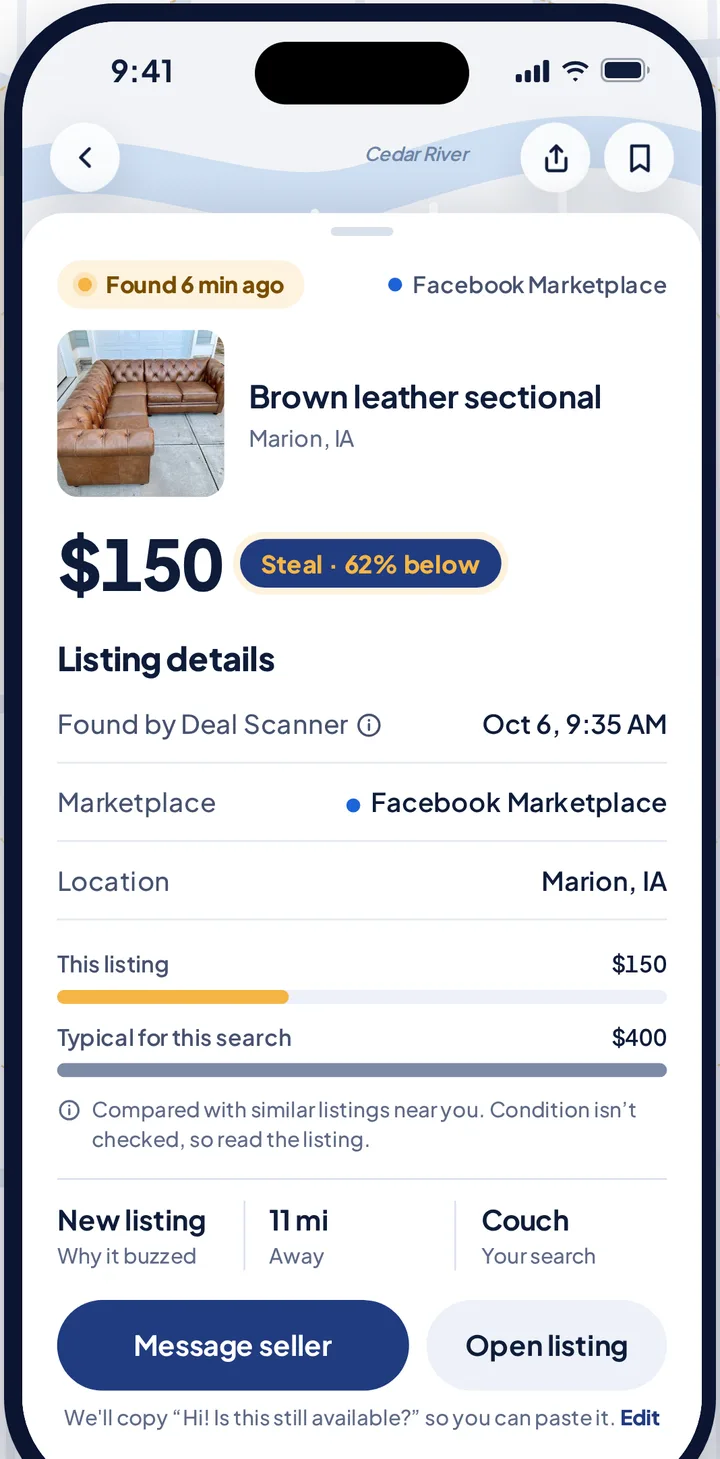
The honest comparison is with the last several kayaks like it asking near you right now. Deal Scanner does this for you: once a search has seen a few listings, each new one gets a Deal Score showing how far under the typical asking price for that search near you it sits. The ones far below typical are the ones worth the drive, after the hull and the hatches check out.
Hearing about it first
A name-brand kayak with a paddle at a fair price goes to the first person who messages. They are cheap enough that nobody haggles for a week, and the good ones are gone the day they are listed. Facebook's own saved-search alerts are hours to days late, loosely filtered, and turn themselves off, so the notification tends to land after the boat is gone. The fixes for Facebook's alerts are on Facebook Marketplace alerts; OfferUp's and Craigslist's own alerts, and how to set them, are on OfferUp alerts and Craigslist alerts.
Or set one Deal Scanner search: "kayak", your town, how far you would drive, and a price range with a low limit high enough to keep paddles, racks, carts and life jackets off your phone. Deal Scanner watches Facebook Marketplace, OfferUp and Craigslist from that one search, with the app closed, drops most of the accessories and lookalikes, and buzzes you when a listing is posted, Deal Score attached and stamped with when it found it. If a seller drops the price on one you were already alerted about, it buzzes you again with the old price and the new one, which happens a lot with a kayak nobody wants to store all winter. Three searches are $3.99 a month, and you cancel anytime in your phone's subscription settings. Pay for the month you're looking. Cancel when you've got it. If you know the boat you want, use the other two searches for it by name, like "Pelican kayak" or "Old Town."
The other apps that do this are priced like business software, for people who flip for a living. The list, with each app's price checked on its own site, is on best Facebook Marketplace alert apps. If you are looking at something with a motor, our used boat guide and used jet ski guide cover those.
FAQ
What should I look for when buying a used kayak?
Flip it over and check the hull for deep gouges, creased dents and a bent keel. Check for sun damage, cracks in the scupper holes and around the seat and handles, hatch covers and seals, water or a waterline inside, a seat and foot braces that adjust and lock, and a hull number on the back that has not been removed.
How much should I pay for a used kayak?
The typical asking price is $300, with half of listings between $150 and $600, from 613 listings Deal Scanner saw in late October 2026. Fishing, pedal and touring kayaks ask more. Compare with what the exact model costs new and with similar ones near you.
Are scratches on a used kayak a problem?
No. Every used kayak has scratches on the bottom. Deep gouges where the plastic is thin, cracks, and dents with a sharp crease are the problems.
Is a sun-faded kayak still good?
Light fading is cosmetic. Heavy fading with chalky, stiff plastic means years of sun, and that plastic cracks more easily. Press on the hull: it should flex and spring back quietly.
How do I check a used kayak for leaks?
Paddle it for ten minutes and see how much water drains out, or run a few inches of water into the hull with a hose and watch the bottom for drips. Look inside for a dirty waterline and into each scupper hole for cracks.
When is the best time to buy a used kayak?
Fall and winter, when the season is over and sellers want the space. Rental outfitters also sell their fleets then. Prices are highest from late spring through midsummer.
Do I need a title or registration for a used kayak?
In most states, no, not for a kayak you paddle. A few states register them, and a kayak with a motor usually has to be registered. Get a bill of sale with the hull number on it either way.
How do I get alerts when a kayak is listed near me?
Set a Deal Scanner search for "kayak", your town, a radius and a price range. It watches Facebook Marketplace, OfferUp and Craigslist and buzzes your phone when a match is posted, with a Deal Score against the typical price near you.
Sources checked
WaterSportsWhiz's guide to buying used kayaks (where and when to buy, pre-visit questions, inspection checklist, test paddle, when to walk away); Kayak Guru's guide to buying used kayaks (types, quality, extras, the seller); Kayak Manual's what to look for when buying a used kayak (weight, storage condition, seals, stern condition); Deal Scanner's own used kayak price page, generated October 27, 2026; Facebook's, OfferUp's and Craigslist's own safety pages on meeting and payment. Checked November 12, 2026.
Also: Buying a used zero-turn mower Buying a used camper Buying a used jet ski Buying a used generator Buying a used snowmobile Buying a first car Buying a used snowblower Best things to flip on Facebook Marketplace Buying a used boat Buying a used dirt bike Buying a used four-wheeler Buying a used golf cart Buying a used lawn mower Buying a used motorcycle Buying a used trailer Buying a used truck Buying used appliances Buying used furniture Buying used tools Facebook Marketplace fees Facebook Marketplace scams Marketplace tips for buyers How to find deals on Facebook Marketplace How to negotiate on Facebook Marketplace Is Facebook Marketplace safe Facebook Marketplace alerts OfferUp alerts Craigslist alerts Compare 14 alert apps Alert app for iPhone and Android Free alert options Marketplace scanner Marketplace monitor One app for all three Notifications not working? Set up Facebook's own alerts Swoopa alternatives Swoopa pricing Flipify alternatives DealScout alternatives