 Deal Scanner
Buying used
Buying a used zero-turn mower from a private seller
How to buy a used zero-turn mower from a private seller: residential or commercial, deck size and your gate, the hydrostatic drive, the deck and spindles, the engine, hours, the test drive, getting it home, when prices are lowest, the stolen-equipment check, and how to hear about the right one when it is posted.
A used zero-turn mower from a private seller is a good buy if it passes five checks: the hydrostatic drive pulls evenly on both sides with no whine, no leaks and no creeping in neutral, the deck is solid underneath with spindles that do not wobble, the engine starts cold without smoke or a knock, the frame and front casters are straight and tight, and the serial plate is there and matches what the seller tells you. The drive is the one that matters most, because a tired drive can cost more to fix than the mower is worth. Fall and winter are the cheapest time to buy, so if you are shopping now you are early, not late. The details are below, along with how to be the first one to the good listing.
Which kind
- Residential. What the big-box stores sell: a lighter frame, a stamped deck (one sheet of steel pressed into shape), and on many entry-level models a sealed drive unit on each rear wheel that is meant to be replaced, not serviced. Fine for a yard, and the cheapest way in.
- Commercial. Scag, Exmark, Ferris, Grasshopper and the top lines from Toro, John Deere and Kubota: a heavier welded frame, a fabricated deck (thick plate welded together), and drives with filters and fluid you can change. Built to be rebuilt. A commercial machine with a lot of hours can still be the better buy than a residential one with few, if it was looked after.
- Deck size. A rough rule: 42 to 46 inches for up to a couple of acres, 48 to 54 for two to four, 60 and up for more. Before you fall for a 60-inch deck, measure your gate and the shed door. The deck is the widest part of the mower.
- Lap bars or a steering wheel. Nearly all of them steer with two lap bars. A few have a steering wheel. Lap bars take about an hour to learn.
- Your ground. A zero-turn is for open, fairly flat ground. Most owner's manuals say to stay off slopes steeper than about 15 degrees, because the front wheels are casters and do not steer or brake. If your yard is mostly hillside, a riding tractor is the right tool, and our used lawn mower guide covers those.
Before you drive out
- Get the make, the exact model, the year and the hours. Look up that model for known problems and for what it cost new. The model number tells you whether it is the residential or the commercial version, which the listing often does not.
- Ask what it mowed. One homeowner's two acres and a mowing crew's season are different lives. Neither is bad. You just need to know which one you are pricing.
- Ask what has been serviced and when. Engine oil, air filter, blades, deck belt, and on a commercial machine the hydraulic fluid and filters. Receipts or a notebook beat "I change it every year."
- Ask about the drive. "Does it pull the same on both sides? Does it get weak when it is hot?" An honest seller will tell you, and a vague answer is an answer.
- Ask for the serial number and whether they have a receipt or a bill of sale from when they bought it. Mowers have no title, so that paper is the only paper there is.
- Ask the seller not to start it before you get there. A warm engine hides a hard cold start, and you want to see the drive cold and then hot.
- Bring a flashlight, a rag, gloves and a tape measure. And figure out how it is getting home before you go. More on that below.
In the driveway
- Walk around it first. Faded plastic, a torn seat and rust on every bolt mean it lived outside. A machine that was washed and kept in a shed looks like it. Look underneath for fresh oil on the ground.
- Cold start. Put your hand near the engine to check it really is cold. It should fire within a few seconds and settle to an even idle. Blue smoke is burning oil, black is running rich, a knock that follows the revs is the end of that engine. A little smoke on the first second of a cold start that clears is normal on a V-twin that has been sitting.
- Oil. Pull the dipstick. Check the level and the color, and smell it. A gas smell is a carburetor problem that has been thinning the oil. Milky means water. Look for oil leaking where the engine meets its base and around the valve covers.
- Air filter. Pop the cover. A filter packed with dust and grass on a machine that "was just serviced" tells you what the service was.
- The drive units. With the flashlight, look at each rear wheel's drive and every hose and fitting between the pumps and the wheel motors. Dry and dusty is good. Wet, oily dirt caked on one side is a leak. Check the hydraulic fluid level if there is a tank, and that the fluid is clear and not dark, foamy or milky.
- Under the deck. Engine off, key out, spark plug wires pulled. Get down and look underneath. Surface rust is cosmetic. Rust holes, patch plates welded on, and cracks at the welds or around the spindle mounts are not. On a fabricated deck, look for a bent leading edge from hitting a stump.
- Spindles and blades. Grab each blade at the tip and rock it up and down. Any clunk or play is a worn spindle bearing. Spin each one by hand: it should turn smoothly and quietly. Bent or chewed-up blades mean it has hit things, so look harder at the spindle housings above them.
- Belts and pulleys. Cracked, glazed or frayed belts are cheap. A pulley that wobbles or squeals is a bearing. Check the belt guards are still on.
- Frame and front end. Look at the welds where the front caster arms meet the frame; that is where a hard life cracks them. Grab each front caster wheel and rock it: play in the fork or the wheel bearing makes the mower wander and scalp. Check all four tires for dry rot and that the two rear tires match.
- Safety switches. It should not start with the lap bars in or the parking brake off. The blades should stop if you lift off the seat. Bypassed switches are common on used mowers, and they tell you how the rest of it was fixed.
- Hour meter. Check it runs and that the number fits the wear. A seat worn through and paint gone from the foot deck on a meter that says 150 hours means the meter was replaced or unplugged.
The test drive
Do not skip this, and do not let it be thirty seconds. Ten to fifteen minutes is what it takes to get the hydraulic oil hot, and hot is when a tired drive shows itself.
- Bars in neutral, brake off. It should sit still. Creeping forward or back is usually an adjustment, but ask why it was never made.
- Drive straight on flat ground with both bars pushed evenly. A slight drift can be adjusted out. Having to hold one bar well back to go straight means one side is weaker.
- Forward, reverse, spin both ways. It should respond the same in every direction, with no jerk, no lag and no whine that rises with the load.
- Find a slope and climb it. Then do it again at the end of the test, hot. A drive that pulled fine cold and slows or whines on the hill after ten minutes is worn. This is the expensive one. Price it as a drive replacement or walk.
- Engage the blades at full throttle. They should come up to speed quickly without the engine bogging. Listen for a rumble from a spindle or a vibration through the seat, then disengage: the blades should stop within a few seconds.
- Mow something. If the seller will let you cut a strip of their lawn, look at it. An even cut is a level deck and sharp blades. Ridges, a stripe of uncut grass, or scalping on one side is a bent deck, a bent blade or a worn spindle.
- Shut it off and look underneath again. Fresh drips after a hot run are the leaks that a cold look misses.
How many hours is too many
Guides do not agree, and the number means less than who owned it. For a residential zero-turn, a few hundred hours is normal for its age and past 500 to 1,000 it is well used. Commercial machines are a different animal: Grasshopper's own used-mower guide calls one under 1,000 hours low use and says well-maintained ones pass 4,000. A homeowner puts 30 to 50 hours a year on a mower, so divide the hours by the age. A five-year-old residential mower with 900 hours was somebody's business, whatever the listing says.
What a used one costs
Deal Scanner's price pages cover riding mowers as a group, not zero-turns by themselves, so there is no typical zero-turn number from our own listings here, and we will not guess one. The price follows the brand and whether it is residential or commercial, the deck size, the engine, the hours, the season and your area. Look up what that exact model costs new, then compare with the last several like it listed near you. What pushes one down: a weak drive, a rotted or patched deck, a smoking engine, no service history, a mower that lived outside. What pushes it up: a commercial brand, a fabricated deck, low hours with receipts, a bagger or mulch kit, and new tires and blades.
Budget for a first service unless the seller can show you the last one: oil and filter, air filter, fuel filter, blades, and on a serviceable drive the hydraulic fluid and filters.
When to buy
Fall and winter. Once the grass stops growing, a zero-turn is a big thing taking up the garage until April, and there are fewer buyers. Prices climb in early spring and are highest when the first mowing of the year reminds everyone that the old one died. If you are reading this in November, you are buying at the right time. You can still do every check on this page, including the test drive, as long as there is no snow on the ground.
Getting it home
A residential zero-turn weighs several hundred pounds and a commercial one can be well over a thousand. It will not go in a pickup bed without real ramps, and a 60-inch deck will not fit between the wheel wells at all. Most people need a trailer wide enough for the deck, with a ramp gate, and four straps. Measure the deck against the trailer before you leave. Drive it up the ramp slowly and straight; the back end is heavy and they can tip backwards on a steep ramp. If the seller's listing includes a trailer, our used trailer guide covers what to check on that.
The scams and the walk-away signs
- A deposit to hold it. No. Not by Venmo, Zelle or anything else. Too good to be true means it is.
- A commercial machine priced far under the others, a seller who cannot say what model it is or where it was serviced, and a missing or scratched serial plate. Zero-turns walk off landscapers' trailers. Walk.
- "Ran when parked," "just needs a battery," "needs a belt." Maybe. Bring a jump pack and find out, and price it as a project until it proves otherwise.
- Will not let you drive it, or it is already warm when you pull in. There is a reason.
- A whine on the hill, hot. That is the drive. Walk, or pay what a mower that needs a drive is worth.
Meet in daylight, bring a friend, pay when it is loaded, and get a bill of sale with the serial number on it. More on the common ones is on Facebook Marketplace scams.
Why this page exists
I was looking for a cheap car to save on gas and keep miles off my truck. Something that ran and didn't need a new engine or a timing belt. Every time I found one and messaged the seller: sorry, already sold, or there's ten guys ahead of you. And the listing was posted yesterday, or two days ago. I had work all day. You can't sit there refreshing Marketplace every five minutes. It took me almost two months to find a car, and honestly I just got lucky. You have to see the deal for it to happen.
Is the price good?
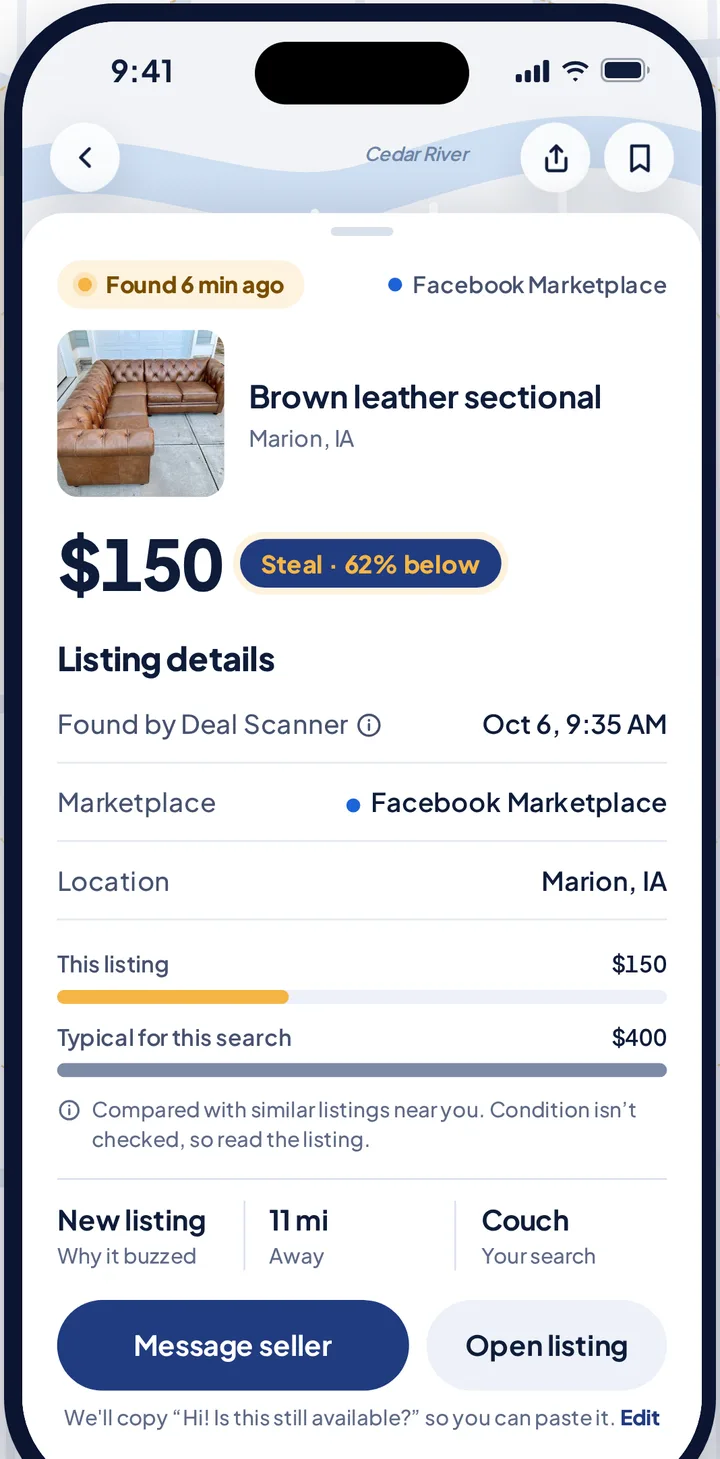
The honest comparison is with the last several zero-turns like it asking near you right now. Deal Scanner does this for you: once a search has seen a few listings, each new one gets a Deal Score showing how far under the typical asking price for that search near you it sits. The ones far below typical are the ones worth the drive, after the drive, the deck and the engine check out. One far below typical in November is an end-of-season seller or a tired drive, and the hill tells you which.
Hearing about it first
A clean commercial zero-turn at a fair price goes to the first person who messages, because the people who mow for a living are watching for the same listing and they know what it is worth. Facebook's own saved-search alerts are hours to days late, loosely filtered, and turn themselves off, so the notification tends to land after the mower is gone. The fixes for Facebook's alerts are on Facebook Marketplace alerts; OfferUp's and Craigslist's own alerts, and how to set them, are on OfferUp alerts and Craigslist alerts.
Or set one Deal Scanner search: "zero turn", your town, how far you would drive with a trailer, and a price range with a low limit high enough to keep blades, belts, baggers and parts mowers off your phone. Deal Scanner watches Facebook Marketplace, OfferUp and Craigslist from that one search, with the app closed, drops most of the accessories and lookalikes, and buzzes you when a listing is posted, Deal Score attached and stamped with when it found it. If a seller drops the price on one you were already alerted about, it buzzes you again with the old price and the new one, which happens a lot with a mower nobody wants to store all winter. Three searches are $3.99 a month, and you cancel anytime in your phone's subscription settings. Pay for the month you're looking. Cancel when you've got it. Use the other two searches for the brands you would actually buy, like "Exmark" or "Scag," because plenty of sellers type the brand and never the words "zero turn."
The other apps that do this are priced like business software, for people who flip for a living. The list, with each app's price checked on its own site, is on best Facebook Marketplace alert apps.
FAQ
What should I check when buying a used zero-turn mower?
The hydrostatic drive first: leaks, whining, creeping in neutral, pulling to one side, and whether it still climbs a slope after ten minutes of running. Then the underside of the deck for rust-through and cracks, the spindles for play, a cold start, the oil, the frame welds and front casters, the safety switches, and a serial plate that is present and readable.
How many hours is a lot on a used zero-turn mower?
For a residential model, past 500 to 1,000 hours is well used. Commercial models are built for more: Grasshopper's used-mower guide calls under 1,000 hours low use and says well-maintained ones pass 4,000. Maintenance matters more than the number.
Is a used commercial zero-turn better than a new residential one?
Often, for the same money, if the drive and deck check out. A commercial machine has a heavier frame, a fabricated deck and drives that can be serviced. It is also bigger and heavier, so make sure it fits your gate and your trailer.
What is the most expensive thing to fix on a zero-turn?
The hydrostatic drive: the pumps and wheel motors, or the sealed drive units on a residential model. A failing drive can cost more than an older mower is worth, which is why the hot test drive on a slope matters.
When is the best time to buy a used zero-turn mower?
Fall and winter, after mowing season ends. Prices climb in early spring.
Do zero-turn mowers have titles?
No. Ask for the seller's original receipt or bill of sale, check the serial plate is there and not scratched, and write the serial number on your own bill of sale.
How do I get alerts when a zero-turn mower is listed near me?
Set a Deal Scanner search for "zero turn", your town, a radius and a price range, and two more for the brands you want. It watches Facebook Marketplace, OfferUp and Craigslist and buzzes your phone when a match is posted, with a Deal Score against the typical price near you.
Sources checked
Tatum Motor Company's tips for buying a used zero-turn mower (physical inspection, engine and battery, hydraulic system); Grasshopper's guide to evaluating a used mower (engine red flags, hydraulic system, deck, maintenance, test drive, hours); AHW's used zero-turn guide (features, condition and longevity); owner's manuals for common residential and commercial zero-turns for the slope limit and safety switches; Facebook's, OfferUp's and Craigslist's own safety pages on meeting and payment. Checked November 12, 2026.
Also: Buying a used kayak Buying a used camper Buying a used jet ski Buying a used generator Buying a used snowmobile Buying a first car Buying a used snowblower Best things to flip on Facebook Marketplace Buying a used boat Buying a used dirt bike Buying a used four-wheeler Buying a used golf cart Buying a used lawn mower Buying a used motorcycle Buying a used trailer Buying a used truck Buying used appliances Buying used furniture Buying used tools Facebook Marketplace fees Facebook Marketplace scams Marketplace tips for buyers How to find deals on Facebook Marketplace How to negotiate on Facebook Marketplace Is Facebook Marketplace safe Facebook Marketplace alerts OfferUp alerts Craigslist alerts Compare 14 alert apps Alert app for iPhone and Android Free alert options Marketplace scanner Marketplace monitor One app for all three Notifications not working? Set up Facebook's own alerts Swoopa alternatives Swoopa pricing Flipify alternatives DealScout alternatives