 Deal Scanner
Buying used
Buying a used snowmobile from a private seller
How to buy a used snowmobile from a private seller: trail, crossover, mountain or utility, two-stroke vs four-stroke, the tunnel and bulkhead, skis and front end, the track and slides, a compression test, the clutches, paperwork and the serial number, when prices are lowest, and how to hear about the right sled when it is posted.
A used snowmobile from a private seller is a good buy if it passes six checks: the tunnel and bulkhead are straight (no crash), the skis and front end have no play, the track and slides have life in them, the engine starts cold and has even compression, the clutches and belt are clean and not glazed, and the serial number on the tunnel matches the title or registration. Buy the kind of sled that fits where you ride, look at it in the spring or summer if you can, and expect November and December prices to be the highest of the year. The details are below, along with how to be the first one to the good listing.
Which kind
- Trail. Short track, low and stable, built for groomed trails. Most of the used market, and what most people in the Midwest and the Northeast actually ride.
- Crossover. A longer track and more suspension travel. Trail most days, off-trail and deeper snow some days. A good one-sled answer.
- Mountain. Long, tall-lug track, narrow ski stance, built to climb in deep powder. A handful on a groomed trail. Do not buy one for flat country.
- Utility. Wide track, low gearing, a hitch and a rack. Ice fishing, hauling, trapping, pulling a sled. Slow and unbreakable when looked after.
- Two-stroke or four-stroke. Two-strokes are lighter and simpler, burn oil by design (the oil tank has to be filled, and the oil injection has to work), and are the ones to compression test. Four-strokes are heavier, quieter, easier on gas, and change oil like a car. Either is fine used; ask which one the seller has kept up with.
Before you drive out
- Get the year, make, model and the miles. Look up the model year for known problems before you go. Every brand has a year or two with a weak spot, and owner forums will tell you which.
- Ask for the serial number (VIN) and whether there is a title or a registration in the seller's name. The rules differ by state, so check yours, but a sled with no paperwork and a seller who "lost it" is a sled you may not be able to register.
- Ask the seller not to start it before you get there. A warm engine hides a hard cold start.
- Ask how it was stored. Fogged, stabilized gas, on a stand, under cover, indoors is the right answer. Sitting outside on the grass all summer with gas in it is a carburetor or injector cleaning and maybe more.
- Ask about the trailer. A lot of sleds come with one. Check the trailer's own title, lights and tires; it changes the price.
- Bring a compression gauge if it is a two-stroke and you know how to use one, or bring someone who does. Also a flashlight and a rag.
In the driveway
- Walk around it first. Look down the tunnel from behind and from the side. Ripples, bends or welds in the tunnel or the front bulkhead mean a hit or a rollover. A cracked bulkhead is a front-end crash. Look at the hood and the windshield too, but those are cheap; the frame is not.
- Skis and front end. Look at the A-arms and the radius rods for bends. Grab each ski and wiggle it: play at the spindle is worn bushings or a bent part. Look under the skis at the carbides (the wear bars). Worn flat is a cheap part and a sign of a lot of road crossings.
- Track. Lift the back with help or put it on a stand. Walk the track all the way around by hand. Missing or torn lugs, cuts, exposed rods or a track that has been patched: price in a new track, which is several hundred dollars or more.
- Slides and wheels. The plastic slides (hyfax) the track rides on wear down; look at how much is left and for melted spots, which mean it was run on bare ground or ice with no snow for cooling. Spin every idler wheel. Rough or wobbling is a bad bearing.
- Suspension. Push down hard on the back of the seat and on each side of the front. It should compress and come back smoothly, not bounce or clunk. Look for oil on the shocks.
- Cold start. Choke, pull or key. A few pulls cold is normal. Listen at idle for knocking or a rattle. Watch the exhaust: a puff of smoke at start on a two-stroke is normal; blue smoke that keeps coming on a four-stroke is not.
- Compression (two-stroke). Engine warm, plugs out, throttle open. Both or all cylinders should read close to each other. A big gap between cylinders, or low readings across the board, is a top end coming soon. Pull the plugs and look: tan to light brown is happy; black and wet is rich; white is lean, and lean is how two-strokes melt pistons.
- Clutches and belt. Pull the belt cover. Look at the clutch sheaves (the cone faces) for grooves, glazing and black buildup. Look at the belt for cracks, glazing, missing cogs and flat spots. A belt is cheap; a grooved clutch is not.
- Fluids and leaks. Look for oil, coolant or fuel under the hood and on the floor. Check the chaincase oil if you can (gray is normal wear, metal flakes are not). Cloudy or milky coolant is a problem. Look at the heat exchangers under the tunnel for leaks or dents.
- The rest. Brakes, the throttle snapping back shut, the kill switch, the tether, lights, hand and thumb warmers, the reverse if it has one, and the gauge. Check that the mileage on the gauge and the wear on the seat, grips and running boards tell the same story.
A short warm-up in the driveway is fine. Do not let anyone run it hard or ride it on grass or gravel: a snowmobile cools itself and lubricates its slides with snow. If there is snow, ask to ride it. If there is not, the compression test and the clutch check matter more.
What a used one costs
Deal Scanner's price pages do not cover snowmobiles yet, so there is no typical number from our own listings here, and we will not guess one. The price follows the year, the engine size, the type, the miles, the condition of the track and the clutches, the brand, whether a trailer comes with it, and your area. Look up the year and model in a used-snowmobile price guide such as J.D. Power's, then compare with the last several like it listed near you. What pushes a sled down: a worn track, a tired top end, crash damage on the tunnel, no paperwork. What pushes it up: low miles, the service records, a newer model year, a trailer and the gear thrown in.
When to buy
Spring and summer, when the snow is gone and nobody wants a sled taking up the garage. Prices climb through the fall and are highest in November and December, right before the first good snow. If you are reading this in November, you are buying at the busy time, so know your number before you go, and be first to the listing when it is a good one.
The scams and the walk-away signs
- A deposit to hold it, or a sled that "ships from out of state." No. Not by Venmo, Zelle or anything else. Too good to be true means it is.
- No title, no registration, or a serial number that is scratched, painted over or does not match the paperwork. Walk. Stolen sleds and trailers move every winter.
- "Ran when parked," "just needs a battery," "lost compression on one cylinder." It is a project. Price it as a project.
- Fresh paint or new plastic on just the front end. Look harder at the bulkhead.
Meet in daylight, bring a friend, and bring the truck and trailer only after the sled checks out.
Why this page exists
I saw an ad for a Marketplace alert app and sprinted to the App Store to download it. Then I found out the cheapest plan was about $30 a month. There's no way that's what this costs. I looked at the competitors and they were the same price or more. So I built something for myself that did the same job, because I didn't want to pay that. Then I figured there were a lot of people just like me who'd love to have this but really don't want to spend $30 to $300 a month on it.
Is the price good?
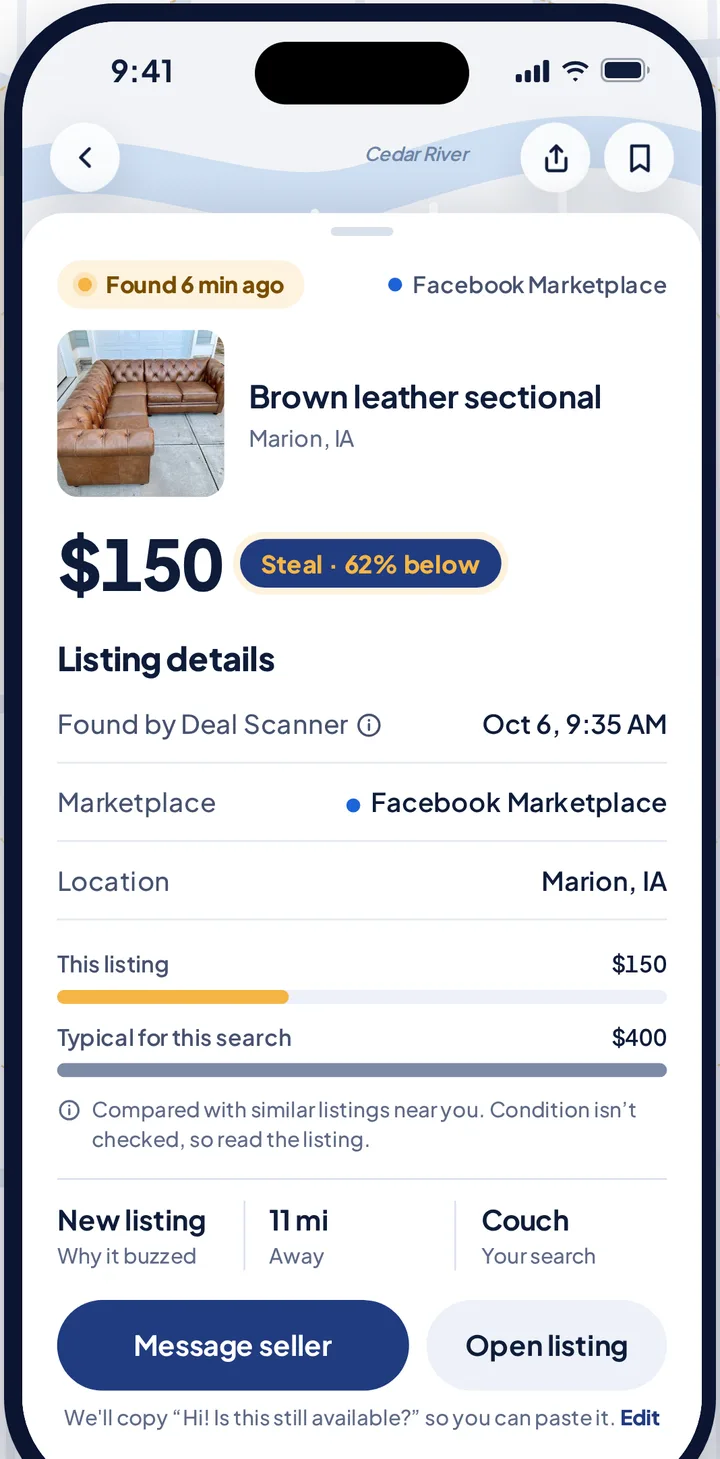
The honest comparison is with the last several sleds like it asking near you right now. Deal Scanner does this for you: once a search has seen a few listings, each new one gets a Deal Score showing how far under the typical asking price for that search near you it sits. The ones far below typical are the ones worth the drive, after the tunnel, the track and the compression check out.
Hearing about it first
A clean, running trail sled at a fair price sells fast in the fall, usually to the first person who messages. Facebook's own saved-search alerts are hours to days late, loosely filtered, and turn themselves off, so the notification tends to land after the sled is gone. The fixes for Facebook's alerts are on Facebook Marketplace alerts; OfferUp's and Craigslist's own alerts, and how to set them, are on OfferUp alerts and Craigslist alerts.
Or set one Deal Scanner search: "snowmobile", your town, how far you would drive with a trailer, and a price range with a low limit high enough to keep covers, helmets and parts listings off your phone. Deal Scanner watches Facebook Marketplace, OfferUp and Craigslist from that one search, with the app closed, drops most of the accessories and lookalikes, and buzzes you when a listing is posted, Deal Score attached and stamped with when it found it. Three searches are $3.99 a month, and you cancel anytime in your phone's subscription settings. Pay for the month you're looking. Cancel when you've got it. Sellers often skip the word "snowmobile," so a second search for "sled" or the brand you want ("Polaris", "Ski-Doo", "Arctic Cat") catches the rest.
The other apps that do this are priced like business software, for people who flip for a living. The list, with each app's price checked on its own site, is on best Facebook Marketplace alert apps. If you are buying the trailer separately, our used trailer guide covers what to check on that.
FAQ
What should I check when buying a used snowmobile?
A straight tunnel and bulkhead, no play in the skis and front end, the track lugs and the slides, smooth suspension, a cold start, even compression on a two-stroke, clean clutch sheaves and a good belt, no fluid leaks, working brakes and controls, and a serial number that matches the title or registration.
Is a two-stroke or four-stroke snowmobile better used?
Either is fine if it was looked after. Two-strokes are lighter and simpler but need working oil injection and a good top end, so compression test them. Four-strokes are heavier and easier on gas and change oil like a car.
How many miles is a lot on a used snowmobile?
It depends on the engine, the type of riding and the care it got, and buying guides disagree on a single number. The condition of the track, the slides, the clutches and the compression tells you more than the gauge does. Check that the miles match the wear on the seat and the grips.
When is the best time to buy a used snowmobile?
Spring and summer, after the snow is gone. Prices are highest in November and December, before the first good snow.
Can you test ride a snowmobile with no snow?
Not safely. A snowmobile uses snow to cool the engine and lubricate the slides, so running it hard on grass, gravel or pavement damages it. A short idle in the driveway is fine; lean on the compression test and the clutch check instead.
How do I get alerts when a snowmobile is listed near me?
Set a Deal Scanner search for "snowmobile", your town, a radius and a price range, and a second one for "sled" or a brand. It watches Facebook Marketplace, OfferUp and Craigslist and buzzes your phone when a match is posted, with a Deal Score against the typical price near you.
Sources checked
J.D. Power's used snowmobile buying checklist; Dennis Kirk's and 4Ridersmag's used-snowmobile guides (tunnel and bulkhead damage, ski and spindle play, track, slides and idler wheels, plugs, compression and clutches); manufacturer owner's manuals for storage and break-in; Facebook's, OfferUp's and Craigslist's own safety pages on meeting and payment. Checked October 30, 2026.
Also: Buying a used kayak Buying a used zero-turn mower Buying a used camper Buying a used jet ski Buying a used generator Buying a first car Buying a used snowblower Best things to flip on Facebook Marketplace Buying a used boat Buying a used dirt bike Buying a used four-wheeler Buying a used golf cart Buying a used lawn mower Buying a used motorcycle Buying a used trailer Buying a used truck Buying used appliances Buying used furniture Buying used tools Facebook Marketplace fees Facebook Marketplace scams Marketplace tips for buyers How to find deals on Facebook Marketplace How to negotiate on Facebook Marketplace Is Facebook Marketplace safe Facebook Marketplace alerts OfferUp alerts Craigslist alerts Compare 14 alert apps Alert app for iPhone and Android Free alert options Marketplace scanner Marketplace monitor One app for all three Notifications not working? Set up Facebook's own alerts Swoopa alternatives Swoopa pricing Flipify alternatives DealScout alternatives