 Deal Scanner
Buying used
Buying a used generator from a private seller
How to buy a used portable generator from a private seller: inverter vs open frame, how many watts you need, the hours, the oil, the cold start, a real load test, the fuel system, stolen units, what a used one costs right now, and how to hear about the right one when it is posted.
A used portable generator from a private seller is a good buy if it passes five checks: it starts cold in a few pulls, it holds steady under a real load you bring yourself, the oil is clean and full, the fuel tank and carburetor are not gummed or rusted, and the hours (if it has a meter) match the story. Pick an inverter for quiet power and electronics, an open-frame for the most watts per dollar, and buy it before storm season, not the day the power goes out. The typical asking price for a used generator across the listings Deal Scanner watches is $450 right now, with half of them between $265 and $800. The details are below, along with how to be the first one to the good listing.
Inverter or open frame
- Inverter. Enclosed, quiet, light for the power, and the electricity comes out clean enough for a laptop, a TV, a furnace control board or a CPAP. Most throttle down at light load, so they sip gas. The small ones (2,000 to 3,500 watts) are the camping and tailgate machines; the bigger ones will run a fridge, a sump pump and the furnace fan. More electronics inside, so more to go wrong if one was cooked or left out in the rain.
- Open frame. The steel tube frame with the engine and the alternator out in the open. Loud, heavy, cheap per watt. This is the job-site and whole-house-backup machine, 5,000 to 10,000 watts and up. Fine for tools, a well pump and most of a house; a little rougher on sensitive electronics than an inverter.
- Dual fuel. Runs on gas or propane. Propane keeps for years in the tank and does not gum the carburetor, which is a big deal for a machine that sits most of the year. Check both fuels run it if the listing says dual fuel.
- Standby. The permanently installed whole-house units. A different purchase (installed, wired, permitted); this page is about portables.
How many watts
Add up what you actually want to run at once. Each thing has a running number and a starting number; anything with a motor (fridge, sump pump, well pump, air compressor, furnace blower) needs two or three times its running watts for a second when it kicks on. The generator's sticker shows two numbers too: running (or rated) watts and starting (or peak, or surge) watts. Size to the running number and make sure the starting number covers your biggest motor.
Roughly: a fridge, a sump pump, a furnace fan, some lights and phone chargers fit on about 5,000 running watts. A well pump or a window air conditioner pushes you higher. If you want to run the house through the panel, that is a transfer switch or an interlock installed by an electrician, never a cord plugged into a dryer outlet.
Before you drive out
- Ask for the model number and look it up: the real running and starting watts, the recall list (the U.S. Consumer Product Safety Commission's site has them), and whether parts are still sold.
- Ask about the hours. Many inverters and some open frames have an hour meter. A homeowner's storm generator usually has very few. A contractor's has a lot. No meter: ask what it was used for and how often.
- Ask the seller not to start it before you get there. A warm engine hides a hard cold start.
- Ask how it was stored. Drained or stabilized gas is a working carburetor. "It's got gas from last winter in it" is a carburetor cleaning.
- Bring a load. A 1,500-watt space heater or a hair dryer is a known, steady load. A circular saw or a shop vac is a motor that tests the surge. A cheap plug-in watt meter tells you the voltage and the frequency.
In the driveway
- Cold start. Fuel on, choke on, pull. Three or four pulls is normal cold. Ten is a carburetor or compression problem. Try the electric start and look at the battery if it has one.
- Let it idle a minute. Steady is right. An engine note that rises and falls in a rhythm is surging, almost always a gummed carburetor. Fixable, but it is a negotiating point.
- Oil. Pull the dipstick or the fill cap. Clean, at the mark, is a cared-for machine. Black, low, milky or smelling of gas means it was not. Ask when it was last changed.
- Load test. Plug in your heater and turn it to high. The engine should pick up, settle and hold. Lights flicker, the engine bogs and dies, or a breaker trips at well under its rating: walk, or price it as a project. Then start your saw or shop vac on top of it and watch the surge. On a watt meter, about 120 volts and 60 hertz, steady, is what you want to see.
- Every outlet. Move the load to each outlet, including the 240-volt twist-lock if it has one and you have a way to test it. Press the reset on each breaker. Check the outlets are not melted or loose.
- Fuel tank and lines. Open the cap and look inside with your phone's flashlight. Rust or flakes in the tank end up in the carburetor. Look at the fuel line for cracks and the petcock for drips.
- Low-oil shutdown and the switch. Ask whether the low-oil shutoff works (most portables have one). Make sure the engine switch actually kills it.
- The frame and the alternator end. Cracked frame welds, a mangled pull cord housing, missing covers on an inverter, or burn marks around the control panel are the end of the inspection on a cheap one.
Fifteen minutes. A generator that ran fine "last time" and will not hold a space heater in the seller's driveway will not hold your fridge in an ice storm either.
What a used one costs right now
Across the 1,230 Craigslist and OfferUp generator listings Deal Scanner saw over three days in late October, the typical asking price is $450, half of them between $265 and $800. It moves a lot by area: under $200 in some places, over $1,000 in others where storms keep demand up. The live number by area is on our generator price page. Roughly:
- Small open frames and older units with a tired carburetor: the low end. Good buys if you can clean a carburetor.
- A running 3,000 to 7,000 watt machine from a brand with parts on the shelf: around typical.
- Big inverters, dual fuel, electric start, low hours, Honda or Yamaha: well above typical, and still under new.
Honda and Yamaha inverters hold their value the longest and parts are everywhere. Champion, Westinghouse, Generac, DuroMax and Harbor Freight's Predator are all over the used listings at fairer prices; check that the exact model's parts are still sold before you buy.
When to buy
Before the season, not during it. Prices climb before hurricane season in the South and before winter up north, and they spike the day a storm is forecast. The weeks after a storm passes, and late spring, are when people who bought in a panic sell. If the power is already out, every good listing is gone and the rest are priced for it.
The scams and the walk-away signs
- A deposit to hold it. No. Not by Venmo, Zelle or anything else. Too good to be true means it is.
- A nearly new machine at a third of the price, no receipt, no serial number. Generators are stolen off job sites and out of garages, especially after storms. Ask for the serial number and the receipt. A seller who will not show the serial plate is answering the question for you.
- "Ran when parked." It did not.
- No video of it running, one photo. Skip.
And one that is not a scam but kills people every winter: run it outside, well away from the house, never in the garage with the door open. Carbon monoxide does not smell like anything.
Why this page exists
I was looking for a cheap car to save on gas and keep miles off my truck. Every time I found one and messaged the seller: sorry, already sold, or there's ten guys ahead of you. And the listing was posted yesterday, or two days ago. I had work all day. You can't sit there refreshing Marketplace every five minutes. It took me almost two months to find a car, and honestly I just got lucky. You have to see the deal for it to happen.
Is the price good?
The price on a used generator depends on the watts, inverter or open frame, the fuel, the brand, the hours, whether it runs, your area, and the weather forecast. The honest comparison is with the last several like it asking near you right now, not a national number. Deal Scanner does this for you: once a search has seen a few listings, each new one gets a Deal Score showing how far under the typical asking price near you it sits. The ones far below typical are the ones worth the drive, after the load test checks out.
Hearing about it first
A running inverter at a fair price sells the day it is posted, and before a storm it sells within the hour to whoever saw it first. Facebook's own saved-search alerts are hours to days late, loosely filtered, and turn themselves off, so the notification tends to land after the generator is gone. The fixes for Facebook's alerts are on Facebook Marketplace alerts; OfferUp's and Craigslist's own alerts, and how to set them, are on OfferUp alerts and Craigslist alerts.
Or set one Deal Scanner search: "generator", your town, how far you would drive, and a price range with a low limit high enough to keep the cords, covers and "for parts" listings off your phone. Deal Scanner watches Facebook Marketplace, OfferUp and Craigslist from that one search, with the app closed, drops most of the accessories and lookalikes, and buzzes you when a listing is posted, Deal Score attached and stamped with when it found it. Three searches are $3.99 a month, and you cancel anytime in your phone's subscription settings. Pay for the month you're looking. Cancel when you've got it. If you want a specific machine, a second search for the brand or model ("Honda EU2200i", "Champion dual fuel") catches the listings that never say "generator" the way you would.
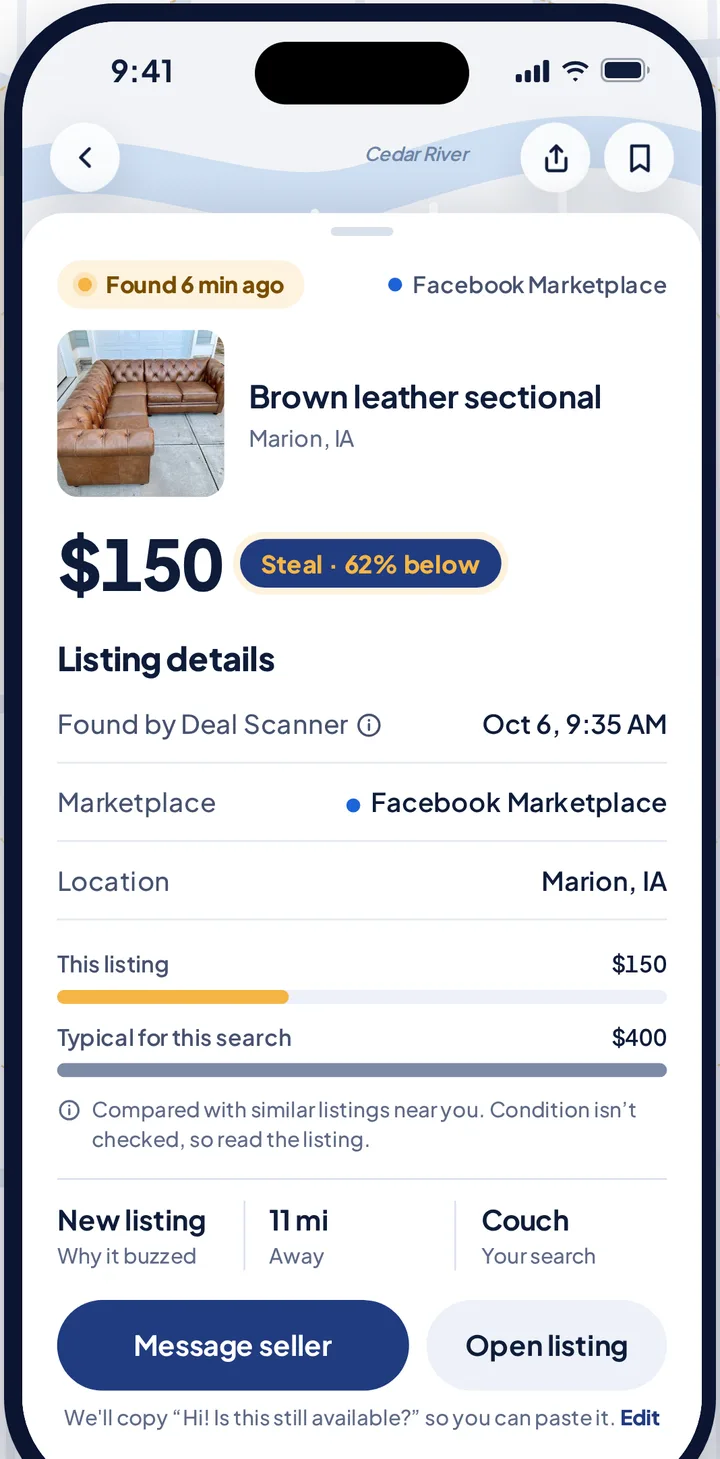
The other apps that do this are priced like business software, for people who flip for a living. The list, with each app's price checked on its own site, is on best Facebook Marketplace alert apps.
FAQ
What should I check when buying a used generator?
A cold start (ask the seller not to warm it up), a steady idle with no surging, clean oil at the mark, a load test with a space heater and a motor you bring, every outlet and breaker, a clean fuel tank, a working engine switch and low-oil shutoff, and the hours if it has a meter. Ask for the model number and the serial number before you go.
Should I buy an inverter or an open-frame generator?
An inverter for quiet running, light weight and clean power for electronics. An open frame for the most watts for the money, for tools, well pumps and whole-house backup. Dual fuel on either is worth having for a machine that sits most of the year.
How many hours is a lot for a used portable generator?
It depends on the engine and how it was looked after, so check the manufacturer's manual for the model. A homeowner's storm generator often has very few hours; a contractor's has many. Clean oil, an easy cold start and a steady load test tell you more than the number alone.
How much does a used generator cost?
The typical asking price across the listings Deal Scanner watches is $450, with half between $265 and $800, and it varies a lot by area. The live number by area is on the generator price page.
When is the best time to buy a used generator?
Before storm season and in the weeks after a storm passes, when people who bought in a panic sell. Prices spike when a storm is forecast.
How do I get alerts when a generator is listed near me?
Set a Deal Scanner search for "generator", your town, a radius and a price range. It watches Facebook Marketplace, OfferUp and Craigslist and buzzes your phone when a match is posted, with a Deal Score against the typical price near you.
Sources checked
Generator Source's and React Power's used-generator buying guides (hours, records, load testing); manufacturer owner's manuals for running vs starting watts and oil service; the U.S. Consumer Product Safety Commission's portable generator safety and recall pages; Deal Scanner's own generator price page from the October 27, 2026 data refresh (1,230 Craigslist and OfferUp listings over three days). Checked October 30, 2026.
Also: Buying a used kayak Buying a used zero-turn mower Buying a used camper Buying a used jet ski Buying a used snowmobile Buying a first car Buying a used snowblower Best things to flip on Facebook Marketplace Buying a used boat Buying a used dirt bike Buying a used four-wheeler Buying a used golf cart Buying a used lawn mower Buying a used motorcycle Buying a used trailer Buying a used truck Buying used appliances Buying used furniture Buying used tools Facebook Marketplace fees Facebook Marketplace scams Marketplace tips for buyers How to find deals on Facebook Marketplace How to negotiate on Facebook Marketplace Is Facebook Marketplace safe Facebook Marketplace alerts OfferUp alerts Craigslist alerts Compare 14 alert apps Alert app for iPhone and Android Free alert options Marketplace scanner Marketplace monitor One app for all three Notifications not working? Set up Facebook's own alerts Swoopa alternatives Swoopa pricing Flipify alternatives DealScout alternatives