 Deal Scanner
Buying used
Buying a used snowblower from a private seller
How to buy a used snowblower from a private seller without buying someone else's problem: single-stage vs two-stage, the cold start, the auger and shear pins, the gearbox, belts, tires and rust, what a used one costs right now, when to buy, and how to hear about the right one when it is posted.
A used snowblower from a private seller on Facebook Marketplace, OfferUp or Craigslist is one of the best buys of the year if you check five things: it starts cold, the auger and impeller turn with no play, the auger gearbox is not leaking, the belts and tires have life in them, and the bucket is not rusted through. Get a two-stage machine if you have a real driveway and real snow, a single-stage if you have a short flat one, and buy it in October or in the spring, not the morning after the first storm. The typical asking price for a used snowblower across the listings Deal Scanner watches is $300 right now, and the details are below, along with how to be the first one to the good listing.
Which kind
- Single-stage. A rubber-edged auger scoops the snow and throws it in one motion. Light, cheap, pulls itself along on the rubber paddles. Good for a one- or two-car driveway, a few inches at a time, on pavement. Useless on gravel (it throws the gravel) and in the wet heavy stuff at the end of the driveway the plow leaves.
- Two-stage. A steel auger breaks the snow up and feeds it to an impeller that throws it. Engine-driven wheels or tracks. Skid shoes hold the bucket off the ground, so gravel is fine. This is the one for a long driveway, a foot of snow, or anywhere the plow berm is a wall. Heavier, more to check, worth more used.
- Three-stage. A two-stage with an accelerator in the middle. Faster through deep snow, more parts. Rarer used; treat it as a two-stage with one more thing to spin.
- Electric and battery. Cordless single-stage machines are fine for light snow and a short driveway. Used, the battery is the whole question: ask its age, watch it run for ten minutes, and price a replacement battery before you pay.
If you are not sure, a two-stage 24-inch with a 200cc-class engine is what most of the country needs and what most of the used listings are.
Before you drive out
- Ask for the model number. It is on a sticker on the frame or under the handlebar. Look it up: parts availability, the engine it came with, and any recall. A machine whose parts are discontinued is a machine you cannot fix.
- Ask what it does and does not do. "Starts first pull" and "throws great" are the two claims. Ask the seller not to start it before you get there. A warm engine hides a 20-pull cold start.
- Ask about the gas. Stabilized or ethanol-free gas and a drained tank in April means a carburetor that works. A blank look means plan on cleaning it.
- Ask where it lived. Inside a garage, or under a tarp against the shed. Rust tells you the truth when you get there anyway.
- Bring an extension cord if it has electric start. Sellers never have one handy, and the electric start is the thing you will use most in January.
In the driveway
- Cold start. Prime, choke, pull. Two or three pulls is normal for a cold engine. Ten is a carburetor or compression. Try the electric start too. Then let it idle: surging (the engine note rising and falling in a rhythm) is a gummed carburetor, not the end of the world, but it is $60 to $120 at a shop or an afternoon of yours.
- Full throttle, then load. Engage the auger and listen. Grinding, knocking, a rattle that was not there at idle, or an engine that bogs and dies when the auger engages: walk. Blue smoke at full throttle is an engine using oil.
- Oil. Pull the dipstick. Honey-colored and at the mark is a cared-for machine. Black, low, or milky means it was not.
- Auger and impeller. Engine off. Grab the auger and try to wiggle it side to side and in and out. Spin the impeller by hand (gloves). Play at the shaft means bushings or bearings. Check that the shear pins holding the augers are real shear pins, not grade-8 bolts somebody put in because they kept breaking; a bolt where a shear pin should be means the next rock takes out the gearbox instead of a $3 pin.
- Auger gearbox. The housing in the middle of the auger. Look for oil weeping from the seams or the shaft seals. A leaking gearbox is the single most expensive part on a two-stage and the reason some "runs great" machines are cheap.
- Belts. Pull the belt cover (two or three bolts). Cracked, glazed or frayed belts are a cheap fix but a negotiating point. Watch the auger belt engage: it should grab, not slip and squeal.
- Drive. Put it in each gear, forward and reverse, and let it pull itself. A friction disc that slips in every gear is a worn disc, cheap on most machines but check the model. Tracks: look at the rubber for cracks and the tension.
- Tires. Deep cracks, no tread, or one that will not hold air. Snowblower tires are not expensive but they are annoying to change.
- Rust. Surface rust on the bucket is normal. Rust-through at the bottom of the bucket, around the skid shoes, where the bucket bolts to the frame, or on the chute's base is the end of the inspection on a cheap machine. Check the scraper bar under the bucket: worn thin is a $30 part, rusted off is a bucket that was dragged for years.
- Chute and controls. Rotate the chute all the way both directions and tilt the deflector. Squeeze every control lever and watch what moves. Check the cables are not frayed and the handlebar is not loose where it bolts to the frame.
Fifteen minutes. If the seller gets impatient at minute five, that tells you something too.
What a used one costs right now
Across the Craigslist and OfferUp listings Deal Scanner watched over three days in late October, the typical asking price for a used snowblower is $300, and it moves a lot by area, from under $200 in some places to $500 and up in others. The live number by area is on our snowblower price page. Roughly, from the listings:
- Older single-stage and small two-stage machines with a tired carburetor: the low end. These are the ones to buy and fix if you know a carburetor.
- A running 24-inch two-stage from a brand with parts on the shelf: around typical.
- A late-model two-stage, big engine, tracks or a wide bucket, with the receipts: well above typical, and still half of new.
Brand matters for parts and resale more than for how well it throws snow. Ariens, Toro and Honda hold their value and have parts everywhere. The budget brands built by MTD (Troy-Bilt, Yard Machines, Craftsman in many years, older Cub Cadet) are fine machines at a fair price and most of the parts are shared and cheap; the thing to check is that the exact model's parts are still sold.
When to buy
Prices are lowest in spring, when people want the garage back, and in September and October, when they have already upgraded and the old one is in the way. They jump the morning after the first real snow and stay there until the thaw. If you are reading this in October you are early. If you are reading it on the day of the storm, every good listing is already gone and the rest are priced for panic.
The scams and the walk-away signs
- A deposit to hold it. No. Not by Venmo, Zelle or anything else. Too good to be true means it is.
- "Ran when parked." It did not. Priced as a project or not at all.
- No model number, no engine running in the video, one photo. Skip.
- A near-new machine at a third of the price from a profile with nothing on it. Stolen or fake. Either way, not yours.
Meet in daylight, bring a friend to help load it, and bring the extension cord.
Why this page exists
I saw an ad for a Marketplace alert app and sprinted to the App Store to download it. Then I found out the cheapest plan was about $30 a month. There's no way that's what this costs. I looked at the competitors and they were the same price or more. So I built something for myself that did the same job, because I didn't want to pay that. Then I figured there were a lot of people just like me who'd love to have this but really don't want to spend $30 to $300 a month on it.
Is the price good?
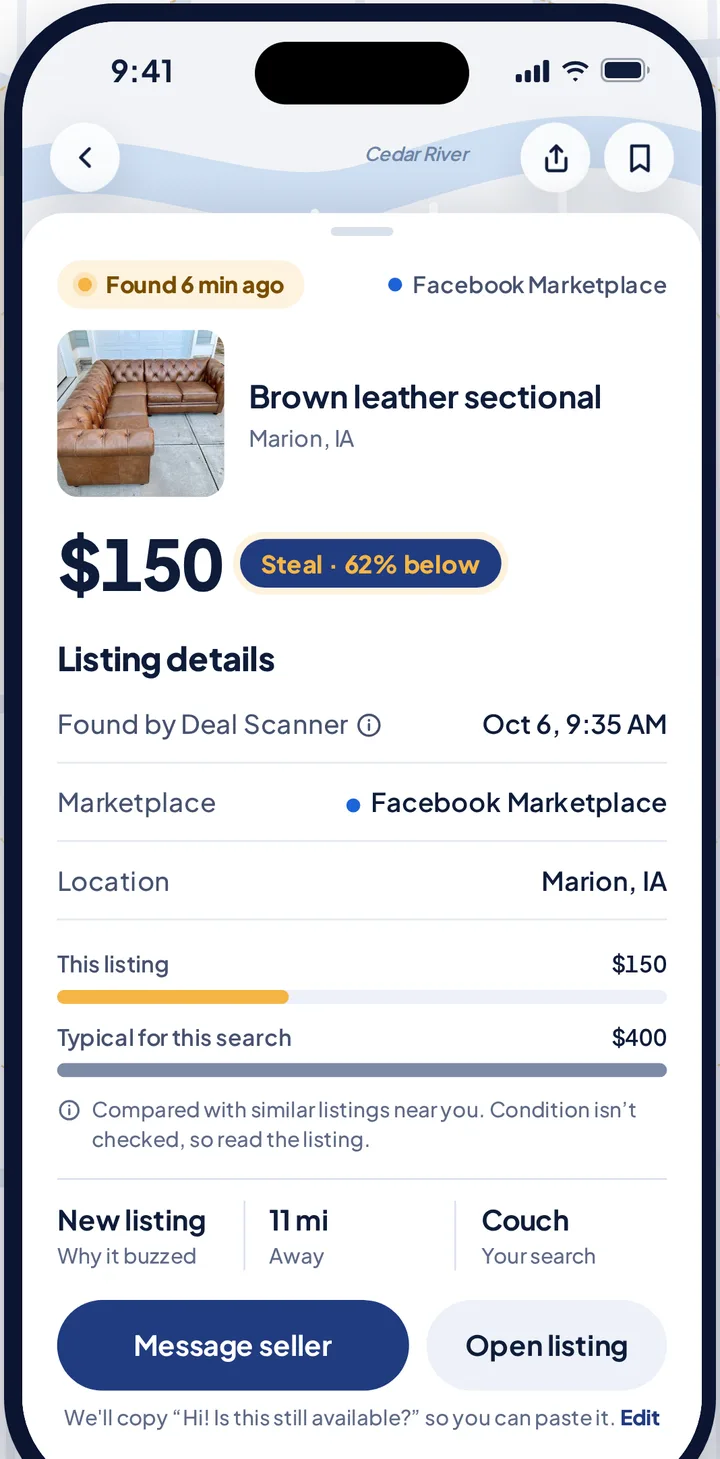
The price on a used snowblower depends on the type, the width, the engine, the brand, the age, whether it runs, and your area, and the whole market moves with the forecast. The honest comparison is with the last several like it asking near you right now, not a national figure. Deal Scanner does this for you: once a search has seen a few listings, each new one gets a Deal Score showing how far under the typical asking price near you it sits. The ones far below typical are the ones worth driving to, after the cold start and the gearbox check out.
Hearing about it first
A running two-stage at a good price in snow country sells the day it is posted, usually to the first person who saw it. Facebook's own saved-search alerts are hours to days late, loosely filtered, and turn themselves off, so the notification tends to land after the machine is gone. The fixes for Facebook's alerts are on Facebook Marketplace alerts; OfferUp's and Craigslist's own alerts, and how to set them, are on OfferUp alerts and Craigslist alerts.
Or set one Deal Scanner search: "snowblower", your town, how far you would drive with a trailer or a truck, and a price range with a low limit high enough to keep the "for parts" listings off your phone. Deal Scanner watches Facebook Marketplace, OfferUp and Craigslist from that one search, with the app closed, drops most of the accessories and lookalikes (the shear pins, the covers, the snow shovels), and buzzes you when a listing is posted, Deal Score attached and stamped with when it found it. Three searches are $3.99 a month, and you cancel anytime in your phone's subscription settings. Pay for the month you're looking. Cancel when you've got it. If you are after a specific machine, a second search for the brand ("Ariens", "Toro") catches the listings that never say "snowblower" in the title.
The other apps that do this are priced like business software, for people who flip for a living. The list, with each app's price checked on its own site, is on best Facebook Marketplace alert apps.
FAQ
What should I check when buying a used snowblower?
A cold start (ask the seller not to warm it up), the engine under load with the auger engaged, the oil, play in the auger and impeller shafts, real shear pins instead of bolts, a dry auger gearbox, the belts, the drive in every gear, the tires, rust at the bottom of the bucket and the scraper bar, and that the chute and every control works.
Is a single-stage or two-stage snowblower better?
Two-stage for a long driveway, deep or wet snow, gravel, or the plow berm. Single-stage for a short paved driveway and a few inches at a time. Most of the used listings are 24-inch two-stage machines, and that is what most people need.
How much does a used snowblower cost?
The typical asking price across the listings Deal Scanner watches is $300, ranging from under $200 to $500 and up by area and machine. The live number by area is on the snowblower price page.
When is the best time to buy a used snowblower?
Spring and early fall, when people want the garage space. Prices jump after the first real snow and stay up until the thaw.
What brand of used snowblower should I buy?
Ariens, Toro and Honda hold their value and have parts everywhere. MTD-built brands (Troy-Bilt, Yard Machines, many Craftsman years) are fine at a fair price if the exact model's parts are still sold. Check the model number before you drive out.
How do I get alerts when a snowblower is listed near me?
Set a Deal Scanner search for "snowblower", your town, a radius and a price range. It watches Facebook Marketplace, OfferUp and Craigslist and buzzes your phone when a match is posted, with a Deal Score against the typical price near you.
Sources checked
Ariens, Toro and Honda owner's manuals and parts lookups for shear pins, skid shoes and belt service; Deal Scanner's own snowblower price page from the October 27, 2026 data refresh (784 Craigslist and OfferUp listings over three days); Facebook's, OfferUp's and Craigslist's own safety pages on meeting and payment. Checked October 29, 2026.
Also: Buying a used kayak Buying a used zero-turn mower Buying a used camper Buying a used jet ski Buying a used generator Buying a used snowmobile Buying a first car Best things to flip on Facebook Marketplace Buying a used boat Buying a used dirt bike Buying a used four-wheeler Buying a used golf cart Buying a used lawn mower Buying a used motorcycle Buying a used trailer Buying a used truck Buying used appliances Buying used furniture Buying used tools Facebook Marketplace fees Facebook Marketplace scams Marketplace tips for buyers How to find deals on Facebook Marketplace How to negotiate on Facebook Marketplace Is Facebook Marketplace safe Facebook Marketplace alerts OfferUp alerts Craigslist alerts Compare 14 alert apps Alert app for iPhone and Android Free alert options Marketplace scanner Marketplace monitor One app for all three Notifications not working? Set up Facebook's own alerts Swoopa alternatives Swoopa pricing Flipify alternatives DealScout alternatives