 Deal Scanner
Buying used
Buying a used camper from a private seller
How to buy a used camper or travel trailer from a private seller: pop-up, travel trailer, fifth wheel or truck camper, what your truck can tow, water damage on the roof, walls and floor, tire date codes, the frame, brakes and hitch, propane, the fridge, furnace and air conditioner, plumbing, slides and awning, the title and VIN, when prices are lowest, and how to hear about the right one when it is posted.
A used camper from a private seller is a good buy if it passes one big check and five smaller ones. The big one is water: no soft spots in the roof or the floor, no bubbles in the walls, no stains in the corners, no musty smell. Then the tires are not aged out, the frame, axles, brakes and hitch are sound, everything that runs on propane, 12 volts and shore power works, the plumbing holds water, and the VIN on the frame matches a title in the seller's name. Make sure your truck can tow it before you fall in love with it, and expect the best prices in the fall and winter. The details are below, along with how to be the first one to the good listing.
This page is about campers you tow or carry: pop-ups, travel trailers, fifth wheels and truck campers. A motorhome is all of this plus an engine and a drivetrain to check.
Which kind
- Pop-up (tent trailer). Light, cheap, tows behind almost anything, stores in a garage. Canvas, a lift system and not much else. The canvas and the lift are the two things that cost money.
- Travel trailer. The hard-sided camper on a bumper hitch, from 13 feet to over 30. Most of the used market. Beds, a kitchen, usually a bathroom.
- Fifth wheel. Hitches in the bed of a pickup. More room and a steadier tow, and it needs a truck with the hitch and the payload for it.
- Truck camper. Slides into the bed. No trailer to tow, and the truck's payload is the limit.
- Size it to your truck first. Find the camper's weight sticker, usually on the outside front left or inside a cabinet door. The number that matters is the GVWR, the most it can weigh loaded, not the dry weight in the ad. Compare it with your vehicle's tow rating and payload in the owner's manual, and leave room; a common rule of thumb is to stay under about 80% of the tow rating. A camper your truck cannot pull safely is not a deal at any price.
Before you drive out
- Get the year, make, model, length and the GVWR. Look up the floor plan so you know what it should look like inside.
- Ask for the VIN and whether there is a clean title in the seller's name. There is no Carfax for most towables, so the history comes from the seller. Ask if there is a loan on it; if there is, the lender holds the title and the sale has to go through them.
- Ask straight out: has it ever leaked, and where? Then ask what was done about it. An honest "the front window leaked, I resealed it and replaced that panel" is a better answer than "never."
- Ask how it was stored. Under a roof or a fitted cover is best. Outside under a blue tarp traps moisture and is hard on the roof.
- Ask the seller to have it plugged in, the propane on, and the fridge started the night before. An RV fridge takes hours to get cold. You cannot check one that was turned on when you pulled in.
- Ask if it is winterized. In November it probably is, which means antifreeze in the lines and no easy way to run the water. More on that below.
- Bring a flashlight, a ladder if the camper has none, a tire gauge, and a cheap outlet tester. A moisture meter is about $30 and worth it on a camper you are serious about.
The roof, walls and floor: look for water first
Water kills campers. A leak rots the wood framing inside the walls and the floor, and by the time you can see it, the repair is big. Check this before anything else, and if it fails, the rest does not matter.
- Roof. Get up on the ladder, and walk it only if the seller says it is a walk-on roof. Look at every seam and around every vent, the air conditioner, the antenna and the ladder mounts. The sealant should be flexible and unbroken. Dried, cracked or peeling sealant is a leak that has started or is about to. A big area of fresh sealant or roof tape in one spot is a repair; ask what happened there. Press with your hand: soft or spongy is rot underneath.
- Outside walls. Sight down each side. Fiberglass walls should be flat; bubbles, waves or a spot that pushes in means the skin has let go from the wood behind it (delamination), and water did that. On aluminum siding, look for ripples and stains under the windows and at the corners.
- Windows, doors and corners. Look at the sealant around every window, door, hatch and light. Look at the bottom corners of the camper and the trim along the bottom edge.
- Inside ceiling and walls. Stains, ripples in the wallpaper, a panel that looks newer than the others, soft spots when you press. Look in the top corners, around the vents and the air conditioner, and under every window.
- Inside every cabinet and under the beds. This is where a leak shows that the owner has not noticed or did not clean up. Use the flashlight. Open the outside storage doors and look up.
- Floor. Walk every foot of it, slowly, in your socks if you have to. Soft, springy or sloping spots are rot. The usual places: in front of the door, the corners, around the toilet and the shower, under the windows, and in front of the fridge.
- Smell. Musty is mold, and mold is water. Air freshener in every room is not a good sign either.
Tires, frame, brakes and hitch
- Tires. Camper tires age out before they wear out. Find the DOT code on the sidewall; the last four digits are the week and year it was made. Most guides say five to seven years is the limit no matter how good the tread looks. Old tires are a blowout on the drive home, so price in a set if they are past it. Check the spare.
- Frame and underside. Get under it. Surface rust is normal; flaking, scaling rust or a cracked weld is not. Look at the spring hangers, the leaf springs and the axles. Look at the belly for sagging, holes and old water stains.
- Brakes and bearings. Most campers over a certain weight have electric brakes and a breakaway switch. Ask when the bearings were last packed. If you can tow it around the block with a brake controller, do; the camper should pull straight and you should feel it slow itself.
- Hitch and jack. Check the coupler latch, the safety chains, the wiring plug, the tongue jack up and down, and every stabilizer jack.
- Lights. Plug it into your truck and check the running lights, brake lights and both turn signals.
The systems
Run everything, twice if you can: once on shore power and once on the battery and propane.
- Battery and 12-volt. Check the battery's date. Unplug the camper and turn on the lights, the fans and the water pump; they should all run off the battery.
- Shore power. Plugged in, check every outlet with the tester, the microwave, and that the battery is charging.
- Propane. Look at the date stamped on the tanks and the condition of the hoses and the regulator. Light every burner on the stove. A propane smell anywhere is a stop.
- Fridge. It should be cold from the night before. Most run on both propane and electric; ask the seller to switch it over so you see both work.
- Furnace and water heater. Turn the thermostat up and wait for heat at the vents. Light the water heater, but only if it has water in it.
- Air conditioner. Shore power, 15 to 20 minutes. It should blow cold, not just loud.
- Plumbing. If it is not winterized: fill the fresh tank or hook up a hose, run the pump, open every faucet hot and cold, flush the toilet, run the shower, and then look under every sink and around the toilet and the water heater for drips. The pump should shut off and stay off when the faucets are closed; a pump that keeps kicking on is a leak somewhere. Pull the dump valves and check they move.
- Slides and awning. Run every slide all the way out and in. It should move evenly and quietly, and the seals should be soft and whole. Roll the awning out and look at the fabric and the arms.
- Detectors. The propane, carbon monoxide and smoke detectors have dates on them and they expire. Cheap to replace, and a sign of how the camper was kept.
- On a pop-up. Crank it all the way up and all the way down. The lift should run smooth and stay up. Look over every inch of canvas for mildew, tears and bad seams, and at the zippers and the screens.
If it is winterized and the seller will not de-winterize it, you cannot test the plumbing or the water heater. That is normal in November and it is still a risk. Ask for a lower price for it, or put in writing on the bill of sale that the seller states the water system has no leaks and the water heater works.
What a used one costs
Deal Scanner's price pages do not cover campers yet, so there is no typical number from our own listings here, and we will not guess one. The price follows the year, the brand, the length and floor plan, slides, condition, and your area. Look up the year and model in J.D. Power's RV values, then compare with the last several like it listed near you. What pushes a camper down: any water damage, old tires, a dead fridge or air conditioner, a soft floor, no title. What pushes it up: stored indoors, new tires and battery, the receipts, and a hitch and the hookup gear thrown in.
Budget for what comes after too: registration and tax, a brake controller and the right hitch for your truck if you do not have them, new tires if they are aged out, and somewhere to park it.
When to buy
Fall and winter. When camping season ends, sellers are looking at a storage bill or a camper in the driveway until May, and there are fewer buyers. Prices climb in early spring and are highest from April through June, when everybody wants one for the summer. If you are reading this in November, you are buying at the right time. The catch is the winterized plumbing above.
The scams and the walk-away signs
- A deposit to hold it, or a camper that "ships" or is "stored with a transport company." No. Not by Venmo, Zelle or anything else. A late-model camper at half price from a seller who cannot meet is the oldest one going. Too good to be true means it is.
- No title, a title in someone else's name, or a VIN on the frame that does not match the paperwork. Walk.
- A soft floor, bubbled walls or a musty smell, and "it just needs a little sealing." It needs a wall or a floor. Walk, or price it as a rebuild.
- Fresh paint or new paneling in one corner only. Look behind it.
- "Never used the bathroom," "everything worked last time we used it." Maybe. Test it.
Meet in daylight, bring a friend, and pay when the signed title is in your hand. More on the common ones is on Facebook Marketplace scams.
How I learned this
I was looking for a cheap car to save on gas and keep miles off my truck. Something that ran and didn't need a new engine or a timing belt. Every time I found one and messaged the seller: sorry, already sold, or there's ten guys ahead of you. And the listing was posted yesterday, or two days ago. I had work all day. You can't sit there refreshing Marketplace every five minutes. It took me almost two months to find a car, and honestly I just got lucky. You have to see the deal for it to happen.
Is the price good?
The honest comparison is with the last several campers like it asking near you right now. Deal Scanner does this for you: once a search has seen a few listings, each new one gets a Deal Score showing how far under the typical asking price for that search near you it sits. The ones far below typical are the ones worth the drive, after the roof, the walls and the floor check out.
Hearing about it first
A dry, clean camper with a title at a fair price goes fast in any season, usually to the first person who shows up with cash and a truck. Facebook's own saved-search alerts are hours to days late, loosely filtered, and turn themselves off, so the notification tends to land after the camper is gone. The fixes for Facebook's alerts are on Facebook Marketplace alerts; OfferUp's and Craigslist's own alerts, and how to set them, are on OfferUp alerts and Craigslist alerts.
Or set one Deal Scanner search: "camper", your town, how far you would drive to tow one home, and a price range with a low limit high enough to keep camper shells, parts and rentals off your phone. Deal Scanner watches Facebook Marketplace, OfferUp and Craigslist from that one search, with the app closed, drops most of the accessories and lookalikes, and buzzes you when a listing is posted, Deal Score attached and stamped with when it found it. If a seller drops the price on one you were already alerted about, it buzzes you again with the old price and the new one, which happens a lot once the snow is coming and the camper is still in the driveway. Three searches are $3.99 a month, and you cancel anytime in your phone's subscription settings. Pay for the month you're looking. Cancel when you've got it. Sellers do not all say "camper," so a second and third search for "travel trailer" and "pop up" or "fifth wheel" catch the rest.
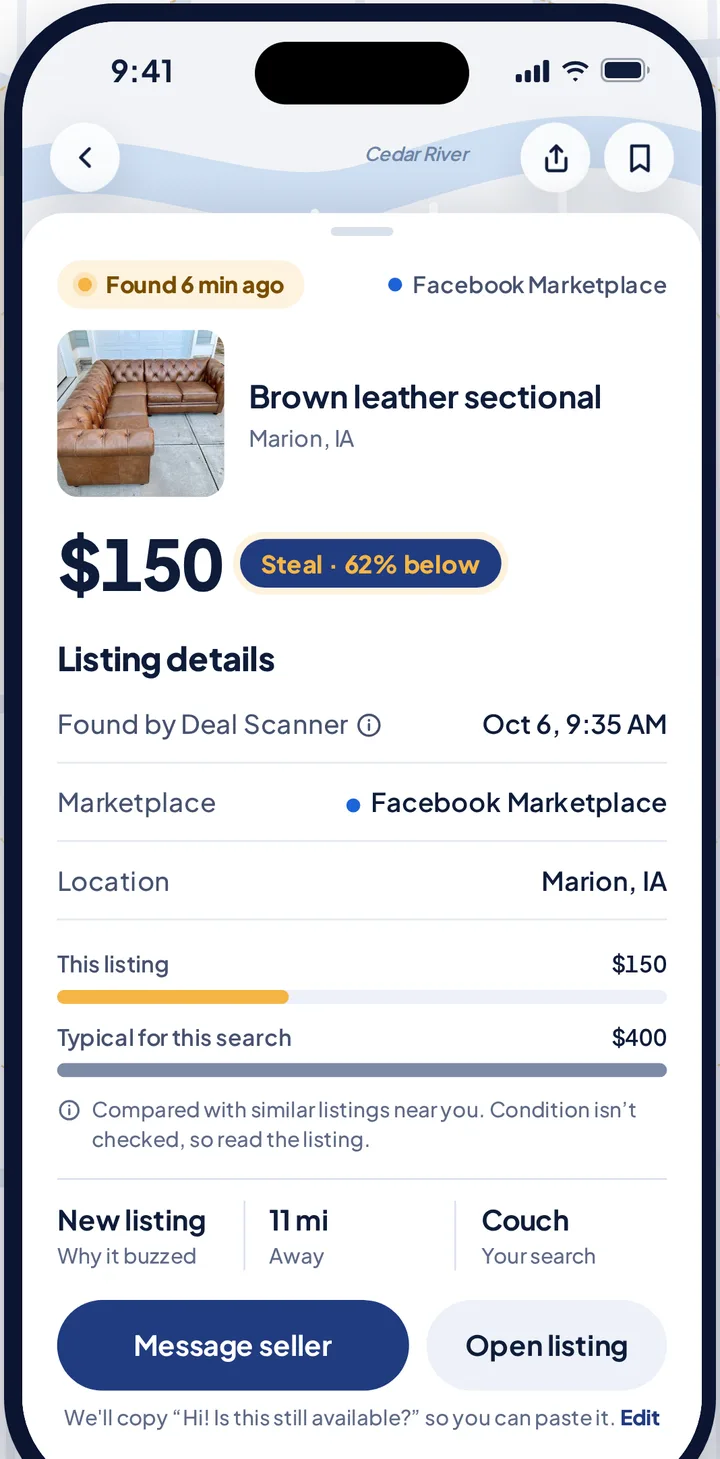
The other apps that do this are priced like business software, for people who flip for a living. The list, with each app's price checked on its own site, is on best Facebook Marketplace alert apps. If you still need something to pull it with, our used truck guide covers that, and the used trailer guide goes deeper on axles, bearings and trailer titles.
FAQ
What should I check when buying a used camper?
Water damage first: the roof sealant, soft spots in the roof and floor, bubbles in the walls, stains inside cabinets and corners, and a musty smell. Then the tire date codes, the frame, brakes, bearings and hitch, the battery, propane, fridge, furnace, water heater and air conditioner, the plumbing, the slides and awning, and a VIN that matches a clean title in the seller's name.
How can you tell if a used camper has water damage?
Soft or spongy spots in the roof or floor, bubbles or waves in the outside walls, stains or rippled paneling on the ceiling and under windows, cracked sealant on the roof, a newer-looking panel in one spot, and a musty smell. Check inside every cabinet and storage bay with a flashlight. A moisture meter helps.
How old is too old for camper tires?
Most guides say five to seven years from the date code, whatever the tread looks like. The last four digits of the DOT code on the sidewall are the week and year the tire was made.
When is the best time to buy a used camper?
Fall and winter, after camping season. Prices climb in early spring and are highest from April through June.
Should I buy a camper that is winterized?
You can, but you cannot test the plumbing or the water heater without de-winterizing it. Ask for a lower price for that risk, or get the seller's statement that the water system works written on the bill of sale. Everything else can still be tested.
Can my truck tow it?
Compare the camper's GVWR on its weight sticker, not the dry weight in the listing, with your vehicle's tow rating and payload in the owner's manual. A common rule of thumb is to stay under about 80% of the tow rating.
How do I get alerts when a camper is listed near me?
Set a Deal Scanner search for "camper", your town, a radius and a price range, and two more for "travel trailer" and "pop up" or "fifth wheel". It watches Facebook Marketplace, OfferUp and Craigslist and buzzes your phone when a match is posted, with a Deal Score against the typical price near you.
Sources checked
J.D. Power's used camping trailer buying checklist (roof and walls, awning and slides, kitchen, power, tires, suspension and brakes, hitch and wiring); Camper FAQs' used travel trailer checklist (roof, walls, slideouts, LP system, undercarriage, electrical, water damage and mold, plumbing, appliances, safety devices, tire age); Camper Smarts' 18 items to check before buying a used RV; Facebook's, OfferUp's and Craigslist's own safety pages on meeting and payment. Checked November 11, 2026.
Also: Buying a used kayak Buying a used zero-turn mower Buying a used jet ski Buying a used generator Buying a used snowmobile Buying a first car Buying a used snowblower Best things to flip on Facebook Marketplace Buying a used boat Buying a used dirt bike Buying a used four-wheeler Buying a used golf cart Buying a used lawn mower Buying a used motorcycle Buying a used trailer Buying a used truck Buying used appliances Buying used furniture Buying used tools Facebook Marketplace fees Facebook Marketplace scams Marketplace tips for buyers How to find deals on Facebook Marketplace How to negotiate on Facebook Marketplace Is Facebook Marketplace safe Facebook Marketplace alerts OfferUp alerts Craigslist alerts Compare 14 alert apps Alert app for iPhone and Android Free alert options Marketplace scanner Marketplace monitor One app for all three Notifications not working? Set up Facebook's own alerts Swoopa alternatives Swoopa pricing Flipify alternatives DealScout alternatives