 Deal Scanner
Buying used
Buying a used golf cart on Marketplace without buying dead batteries
Gas or electric, why the batteries are the whole price on an electric cart, the frame rust nobody looks for, the paperwork question, the scams, how to judge the asking price, and how to get buzzed when the right cart is listed.
Used golf carts are everywhere on Facebook Marketplace, OfferUp and Craigslist, from bone-stock course carts to lifted street rigs, and the price range is wide enough that knowing one thing changes everything: on an electric cart, the battery pack is often a third to half of the cart's value, and a tired pack looks exactly like a fresh one in photos. Here is the gas-versus-electric decision, the inspection, the paperwork, the scams, how to judge the price, and how to be first to the good one.
Gas or electric
Electric is quiet, cheap to run and simple, and its whole cost question is the batteries: a lead-acid pack lasts roughly four to six years and costs $1,000 to $2,000 to replace; a lithium conversion costs more. Gas runs farther and tows, and its questions are the ones a small engine has: cold start, smoke, belts, the clutch. For a neighborhood cart, electric; for a farm or a long property, gas.
Before you drive out
- Ask the battery date. Each battery has a date code stamped on it (a letter for the month and a number for the year is common). A pack over four years old is near the end whatever the seller says.
- Ask for the serial number and a photo of any title, registration or bill of sale. Most states do not title golf carts; some register street-legal ones (LSVs). Know your state. Either way, a serial plate that is missing or ground is a stolen cart.
- Ask whether the charger is included and whether it works. A charger is $200 to $400 if not.
- Ask what it was used for. A course cart has hours; a cart on a salt-treated street has rust.
On the driveway
- Batteries. Pull the seat. Look at the date codes, the terminals for corrosion, the water levels in each cell if they are flooded lead-acid, and swelling or cracks in the cases. Plug in the charger and watch it start. If you brought a meter, check pack voltage after a charge and again after a hard run.
- The run test. Drive it hard up a slope for a few minutes. A tired pack sags, the cart slows, and the meter drops fast. A fresh pack holds.
- Frame. Get under it with a flashlight. Rust scale on the frame rails, especially on carts from coastal or salted-road areas, is the end of the inspection; surface rust is normal.
- Motor and controller (electric). Listen for grinding on acceleration; check for a burnt smell at the controller. Reverse buzzer and forward/reverse switch should work cleanly.
- Engine (gas). Cold start, smoke color, belt condition, clutch engagement, oil level and color, air filter.
- Brakes and steering. Brakes should hold on a slope; steering should have no slop at center. Check the tie rods for play.
- Tires, lift and body. Lifted carts: check the lift kit bolts and the CV boots if it has them. Body cracks are cosmetic; a cracked frame mount is not.
- Lights and street-legal parts if you will drive it on roads: headlights, taillights, turn signals, horn, mirrors, windshield, and whatever your state requires for LSV registration.
The scams
- The deposit to hold it. No.
- The "new batteries" that are not. The date codes are the truth. A seller who will not pull the seat is a seller to skip.
- Stolen carts. They are stolen off courses and out of garages constantly. Serial plate present, matching the paperwork, or walk.
- Too cheap, priced to hurry. A $4,000 cart for $900 with a story is the deposit scam in a different shirt.
Is the price good?
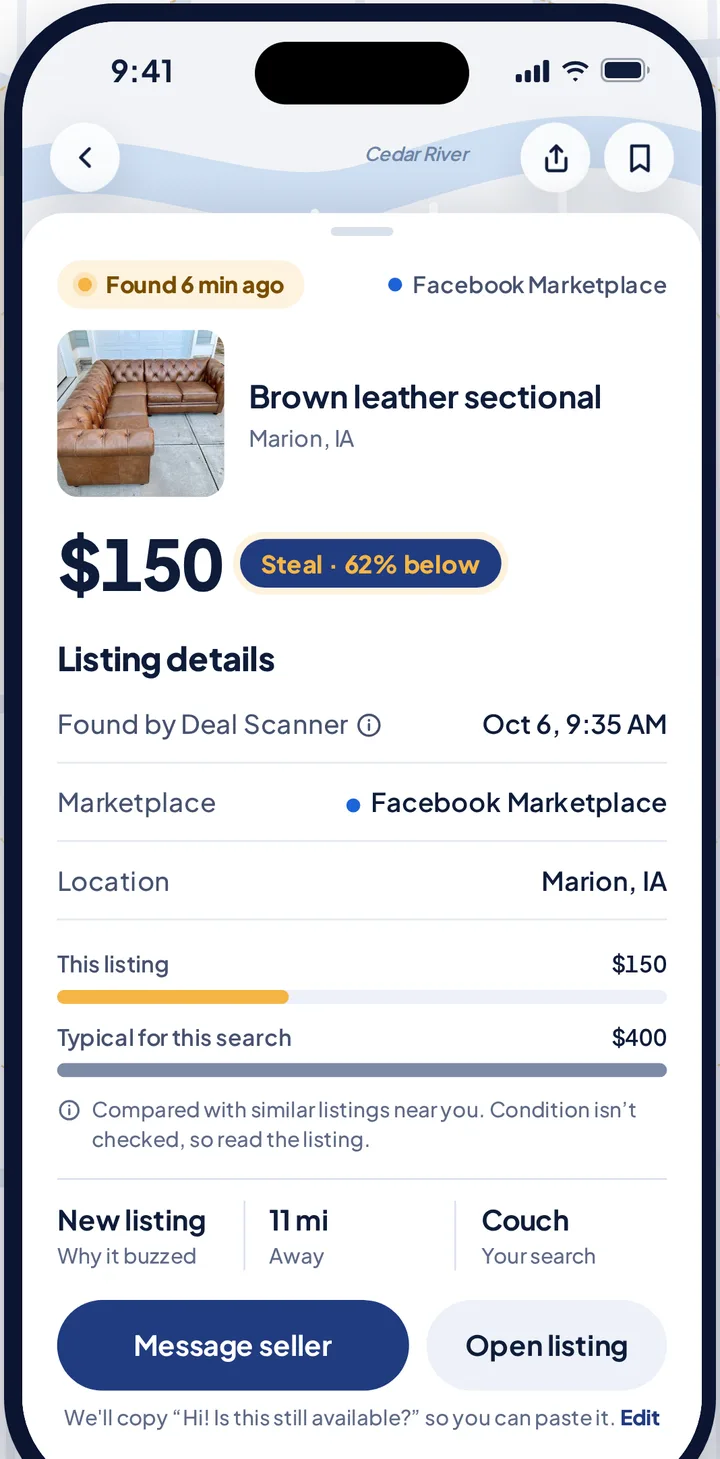
Golf cart prices depend on the make (Club Car, EZGO, Yamaha), the year, gas or electric, the battery age, the lift and the accessories, and the region; prices in a retirement community are a different market from a farm town. The honest comparison is with the last several like it near you. Deal Scanner does this for you: once a search has seen a few listings, each new one gets a Deal Score showing how far under the typical asking price near you it sits. A cart far below typical has old batteries, a frame problem, or a motivated seller, and the inspection tells you which.
Getting there first
Set one search in Deal Scanner for the cart you want ("Club Car Precedent", "EZGO TXT", "Yamaha Drive", "golf cart"), your town and how far you will drive, and a price range with a real low limit. Deal Scanner watches Facebook Marketplace, OfferUp and Craigslist from that one search, with the app closed, and buzzes you when a listing is posted, Deal Score attached. Three searches are $3.99 a month, and you cancel anytime in your phone's subscription settings. Only need it for the month you're looking? Cancel when you've got it. It works for the person who wants one cart for the neighborhood and for the person who buys, lifts and resells them.
FAQ
How do I know if used golf cart batteries are good?
Read the date codes on each battery, check water levels and terminals, charge it and run it hard up a slope. A pack over four years old or one that sags on the hill is near the end.
Do golf carts have titles?
Most states do not title golf carts; some register street-legal low-speed vehicles. Check your state, and always match the serial plate to any paperwork.
How much does a golf cart battery pack cost?
Roughly $1,000 to $2,000 for a lead-acid pack, more for lithium. Price it into any electric cart you look at.
What is a fair price for a used golf cart?
Whatever the same make, year, drive type and battery age is asking near you now. Deal Scanner's Deal Score compares each new listing with the typical asking price your search has seen.
How do I get alerts for golf carts near me?
Set a Deal Scanner search for the model or "golf cart", your town, a radius and a price range. It watches Facebook Marketplace, OfferUp and Craigslist and buzzes your phone when a match is posted.
Sources checked
Battery manufacturers' date-code guides; Club Car, EZGO and Yamaha owner's manuals; state LSV registration pages; Facebook's, OfferUp's and Craigslist's own safety pages. Checked October 26, 2026.
Also: Buying a used kayak Buying a used zero-turn mower Buying a used camper Buying a used jet ski Buying a used generator Buying a used snowmobile Buying a first car Buying a used snowblower Best things to flip on Facebook Marketplace Buying a used boat Buying a used dirt bike Buying a used four-wheeler Buying a used lawn mower Buying a used motorcycle Buying a used trailer Buying a used truck Buying used appliances Buying used furniture Buying used tools Facebook Marketplace fees Facebook Marketplace scams Marketplace tips for buyers How to find deals on Facebook Marketplace How to negotiate on Facebook Marketplace Is Facebook Marketplace safe Facebook Marketplace alerts OfferUp alerts Craigslist alerts Compare 14 alert apps Alert app for iPhone and Android Free alert options Marketplace scanner Marketplace monitor One app for all three Notifications not working? Set up Facebook's own alerts Swoopa alternatives Swoopa pricing Flipify alternatives DealScout alternatives