 Deal Scanner
Buying used
Buying a used jet ski from a private seller
How to buy a used jet ski, Sea-Doo or WaveRunner from a private seller: sit-down or stand-up, two-stroke vs four-stroke, supercharged or not, engine hours, salt water, the hull, under the seat, the pump and impeller, a compression test, the water test, the trailer, the paperwork and hull number, when prices are lowest, and how to hear about the right one when it is posted.
A used jet ski from a private seller is a good buy if it passes six checks: the hull has no cracks or bad repairs underneath, the engine bay under the seat is dry and clean with no corrosion or milky oil, the pump and impeller are not chewed up, the engine starts cold and has even compression, it runs right on the water at full throttle, and the hull number on the back matches the title or registration. Fall and winter are the cheapest time to buy and the hardest time to water test, so if you are shopping now, lean on the compression test and the look under the seat. The details are below, along with how to be the first one to the good listing.
"Jet ski" is what everybody calls them, so that is what this page calls them. Jet Ski is Kawasaki's name, Sea-Doo is BRP's, WaveRunner is Yamaha's, and the general term is personal watercraft, or PWC. Sellers use all of them.
Which kind
- Sit-down, two or three seats. Nearly all of the used market. A three-seater is more stable, carries a passenger without wallowing, and is the one to buy if you will ever tow a tube. In most states towing a rider means a spotter on board too, so check your state's rule before you buy a two-seater for tubing.
- Stand-up. One rider, no seat, a workout. Fun and a different sport. Do not buy one as the family ski.
- Two-stroke or four-stroke. Almost everything built since the mid-2000s is a four-stroke: quieter, easier on gas, oil changes like a car. Older two-strokes are cheap, light and simple, burn oil by design, and are the ones where the compression test matters most. Some lakes restrict the older carbureted two-strokes, so check where you ride before buying one.
- Supercharged or not. A supercharged ski is faster, thirstier, wants premium gas, and has one more expensive part to look after. Ask when the supercharger was last serviced and for the receipt. For a first ski or a family ski, the non-supercharged version of the same model is the easier one to own.
Before you drive out
- Get the year, make, exact model and the hours. Look up that model and year for known problems before you go. Every brand has a year or two with a weak spot, and the owner forums will tell you which.
- Ask how many hours, and where it was ridden. Buying guides vary, but most call under 100 hours low and treat 200 and up as a reason to look harder. Care matters more than the number. A ski with 150 hours and oil changes every season beats one with 40 hours that sat for five years. Salt water is harder on everything; a salt ski that was flushed after every ride is fine, one that was not is corroded where you cannot see.
- Ask for the hull number (the HIN, twelve characters, on the back of the hull) and whether the title or registration is in the seller's name. Some states title a jet ski, some only register it, so check yours. Ask about the trailer's paperwork too; in many states it has its own.
- Ask for the service records and how it was stored. Oil changes, winterizing every fall, indoors or under a cover. "My buddy does all the work" with nothing on paper is worth less than a folder of receipts.
- Ask the seller not to start it before you get there. A warm engine hides a hard cold start.
- Ask whether you can water test it. In season, a seller who will not meet you at a ramp is telling you something. Out of season it may honestly not be possible; then the rest of this list has to carry the weight.
- Bring a flashlight, a rag, and a compression gauge if you know how to use one, or someone who does.
In the driveway
- Hull, top and bottom. Get down and look underneath with the flashlight. Light scratches from beaching are normal. Deep gouges into the fiberglass, cracks, or a patch that does not match the rest are not. Look hard at the keel and the back corners. Sight down both sides for a ripple or a color mismatch that says it was hit and repaired.
- Seat, mats and covers. A torn seat lets water into the foam and is a few hundred dollars to redo. Faded, chalky plastic and a cracked seat mean it lived outside in the sun, and the parts you cannot see lived there too.
- Take the seat off. This is the most important look you get. The bottom of the hull inside should be dry or close to it. Standing water, a waterline stain, silt, or rust on the engine means it took on water or sank at some point. A musty, moldy smell says the same thing. Flaking paint and white crust on the engine and fittings is corrosion, usually salt.
- Oil. Pull the dipstick on a four-stroke. Clean and brown is good. Milky, gray or foamy means water got into the engine. Walk away from milky oil.
- Hoses, clamps, wiring and battery. Soft or cracked hoses, rusty clamps, green corrosion on connectors, and wiring that has been spliced and taped all cost money and time. Check the date on the battery and that the terminals are clean.
- Intake grate, impeller and pump. Look up into the intake under the hull and into the nozzle at the back. The impeller blades should have clean, even edges. Dings, bent blades and a wide gap between the blades and the ring around them mean it sucked up rocks or rope, and it will slip under throttle instead of pulling. Check that the grate is not bent or missing bars.
- Steering and reverse. Turn the bars lock to lock and watch the nozzle at the back: it should follow smoothly with no binding. Work the reverse lever or the brake and reverse system and watch the bucket drop over the nozzle.
- Cold start. It can only run for a few seconds on the trailer without cooling water, or longer on a garden hose hooked to the flush fitting. The hose routine is specific: on most models the engine starts first, then the water goes on, and the water goes off before the engine does. Let the seller do it their way and watch. It should fire quickly, idle evenly, and show no warning lights or beeps on the gauge.
- Gauge and buttons. The hour reading should match what the listing said. Check every button, the trim if it has it, and that the safety lanyard kills the engine when you pull it.
- Compression. Plugs out, throttle open, crank each cylinder. All of them should read close to each other. One low cylinder is a top end or worse. On a two-stroke this test is the whole ballgame. It is a strong check but not the only one: a ski can have good compression and a worn pump.
On the water
If you can get it to a ramp, do it. Fifteen minutes tells you more than an hour in a driveway.
- It should start and idle off the trailer without drama, and shift into reverse and back.
- Run it up to full throttle in open water. It should pull hard and smooth and reach the speed that model is known for. Revs that climb without the ski going faster means the pump is slipping (worn impeller or ring). Surging, a stumble at one speed, or a warning light is a problem to price in or walk from.
- Turn it both ways at speed and check that it tracks straight with the bars centered.
- Shut it off, wait a minute, restart it hot. Some problems only show warm.
- Back on the trailer, take the seat off again. A cup of water in the bottom after a hard ride is normal. A lot of water is a leak: a hose, a seal, or the hull.
The trailer
A lot of jet skis sell with one, and it changes the price. Check the tires for age cracks and wear, spin each wheel and listen for a rough bearing, plug in the lights, look at the frame for rust-through (salt-water trailers rot from the inside), and check the winch strap, the bunks and the coupler. Our used trailer guide covers the rest, including the trailer's own title.
What a used one costs
Deal Scanner's price pages do not cover jet skis yet, so there is no typical number from our own listings here, and we will not guess one. The price follows the year, the model, the hours, supercharged or not, fresh water or salt, whether a trailer and a cover come with it, and your area. Look up the year and model in a used price guide such as J.D. Power's, then compare with the last several like it listed near you. What pushes a ski down: high hours, salt with no flushing, hull repairs, a worn pump, no paperwork. What pushes it up: low hours with the receipts, a newer model year, a good trailer, and two skis sold as a pair on a double trailer.
Budget for what comes after the handshake too: registration, the trailer plate, insurance if you want it or your marina requires it, life jackets, and a first service if the seller cannot show you when the last one was.
When to buy
Fall and winter. From the end of the season until the first warm weekend in spring, sellers are paying for storage, staring at it in the garage, or wanting the money for something else, and there are fewer buyers. Prices climb in spring and are highest around Memorial Day through the Fourth of July. If you are reading this in November, you are buying at the right time. The catch is that it may already be winterized and the ramps may be closed, so you are buying on the driveway checks. Ask for a lower price for the water test you cannot do, or write on the bill of sale what the seller says works.
The scams and the walk-away signs
- A deposit to hold it, or a ski that "ships from out of state." No. Not by Venmo, Zelle or anything else. Too good to be true means it is.
- No title or registration, or a hull number that is scratched off, covered, or does not match the paperwork. Walk. Stolen skis and trailers move every year.
- "Ran great last summer," "just needs a battery," "sat for a few years." It is a project. Price it as a project.
- Milky oil, a waterline inside the hull, or a seller who will not let you take the seat off. Walk.
- Will not water test in July. There is a reason.
Meet in daylight, bring a friend, and pay when the paperwork is signed and in your hand. More on the common ones is on Facebook Marketplace scams.
Why this page exists
I saw an ad for a Marketplace alert app and sprinted to the App Store to download it. Then I found out the cheapest plan was about $30 a month. There's no way that's what this costs. I looked at the competitors and they were the same price or more. So I built something for myself that did the same job, because I didn't want to pay that. Then I figured there were a lot of people just like me who'd love to have this but really don't want to spend $30 to $300 a month on it.
Is the price good?
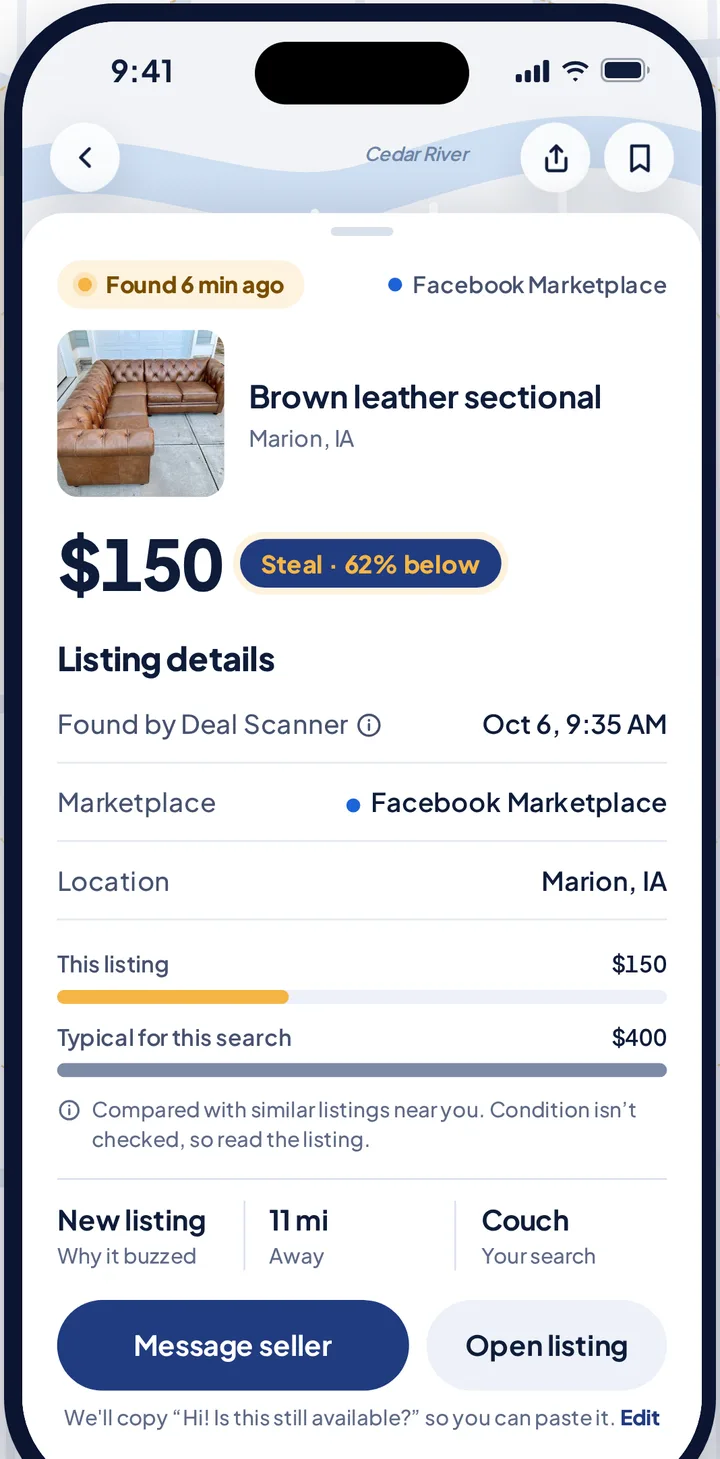
The honest comparison is with the last several skis like it asking near you right now. Deal Scanner does this for you: once a search has seen a few listings, each new one gets a Deal Score showing how far under the typical asking price for that search near you it sits. The ones far below typical are the ones worth the drive, after the hull, the engine bay and the compression check out.
Hearing about it first
A clean, low-hour three-seater with a trailer at a fair price goes to the first person who messages, even in the off season, because the people who know to buy in the fall are all watching for the same listing. Facebook's own saved-search alerts are hours to days late, loosely filtered, and turn themselves off, so the notification tends to land after the ski is gone. The fixes for Facebook's alerts are on Facebook Marketplace alerts; OfferUp's and Craigslist's own alerts, and how to set them, are on OfferUp alerts and Craigslist alerts.
Or set one Deal Scanner search: "jet ski", your town, how far you would drive with a trailer, and a price range with a low limit high enough to keep covers, life jackets and parts listings off your phone. Deal Scanner watches Facebook Marketplace, OfferUp and Craigslist from that one search, with the app closed, drops most of the accessories and lookalikes, and buzzes you when a listing is posted, Deal Score attached and stamped with when it found it. If a seller drops the price on one you were already alerted about, it buzzes you again with the old price and the new one, which happens a lot with a ski nobody wants to store all winter. Three searches are $3.99 a month, and you cancel anytime in your phone's subscription settings. Pay for the month you're looking. Cancel when you've got it. Sellers often skip the words "jet ski," so a second and third search for "Sea-Doo" and "WaveRunner" catch the rest.
The other apps that do this are priced like business software, for people who flip for a living. The list, with each app's price checked on its own site, is on best Facebook Marketplace alert apps. If you are looking at something bigger, our used boat guide covers that.
FAQ
What should I check when buying a used jet ski?
The hull underneath for cracks and repairs, the engine bay under the seat for water, silt, corrosion and smell, the oil for a milky color, the impeller and intake grate for damage, the steering nozzle and reverse, a cold start, even compression across the cylinders, a water test at full throttle if you can get one, the trailer, and a hull number that matches the title or registration.
How many hours is a lot on a used jet ski?
Buying guides vary, but most call under 100 hours low and treat 200 and up as a reason to look harder. Care matters more than the number: regular oil changes, winterizing, flushing after salt water. Check that the hours on the gauge match the wear on the seat, the mats and the grips.
Is a two-stroke jet ski worth buying?
It can be, at the right price, if the compression is even and you know where you will ride it. They are cheap, light and simple. They are also older, parts are getting harder to find for some models, and some lakes restrict the older carbureted ones.
Is a jet ski used in salt water a bad buy?
Not if it was flushed with fresh water after every ride. Look for the proof under the seat: clean fittings and clamps and paint still on the engine. White crust, flaking paint and green connectors mean it was not.
When is the best time to buy a used jet ski?
Fall and winter, after the season ends. Prices climb in spring and are highest from Memorial Day through the Fourth of July.
Can you buy a jet ski without a water test?
You can, and in winter you often have to. Do the look under the seat, the oil check, the pump and impeller check, a cold start on the hose and a compression test, and pay less for the part you could not check.
How do I get alerts when a jet ski is listed near me?
Set a Deal Scanner search for "jet ski", your town, a radius and a price range, and two more for "Sea-Doo" and "WaveRunner". It watches Facebook Marketplace, OfferUp and Craigslist and buzzes your phone when a match is posted, with a Deal Score against the typical price near you.
Sources checked
Neighbor's step-by-step used jet ski inspection guide (hours, service records, compression, hull, intake grate, bilge, water test); Outdoor Troop's 21-point used PWC checklist; Jet Tech's what to check before buying a used jet ski (engine bay cold, hull and deck, intake, pump and impeller, water test, trailer); manufacturer owner's manuals for the flush routine; Facebook's, OfferUp's and Craigslist's own safety pages on meeting and payment. Checked November 11, 2026.
Also: Buying a used kayak Buying a used zero-turn mower Buying a used camper Buying a used generator Buying a used snowmobile Buying a first car Buying a used snowblower Best things to flip on Facebook Marketplace Buying a used boat Buying a used dirt bike Buying a used four-wheeler Buying a used golf cart Buying a used lawn mower Buying a used motorcycle Buying a used trailer Buying a used truck Buying used appliances Buying used furniture Buying used tools Facebook Marketplace fees Facebook Marketplace scams Marketplace tips for buyers How to find deals on Facebook Marketplace How to negotiate on Facebook Marketplace Is Facebook Marketplace safe Facebook Marketplace alerts OfferUp alerts Craigslist alerts Compare 14 alert apps Alert app for iPhone and Android Free alert options Marketplace scanner Marketplace monitor One app for all three Notifications not working? Set up Facebook's own alerts Swoopa alternatives Swoopa pricing Flipify alternatives DealScout alternatives